


How much should you spend on MarTech in 2026, and where should each ringgit go? The honest answer is: it depends on your business model, your customer volume, your integration complexity and your team's ability to operate what you buy. This pillar walks through a defensible way to set that budget, choose between HubSpot, Salesforce and lighter/composable stacks, decide when to hire versus outsource, and pressure-test every renewal. Figures in Malaysian Ringgit are labelled as planning illustrations, not market averages.
Key takeaways
- Budget from operating cadence and customer volume, not headcount or vibes. Tool cost is usually 30–55% of true MarTech spend; integration, data cleanup, ops labour and training make up the rest.
- Stage-based recommendations are decision patterns, not hard rules. A 20-person B2B firm can outgrow HubSpot Marketing Enterprise before a 200-person retailer needs Salesforce Marketing Cloud.
- Hire a MarTech/Marketing Ops specialist when three signals appear: recurring campaign QA failures, attribution disputes across teams, and > 4 tools that need daily reconciliation.
- Agency, freelance and in-house each solve a different problem. Never compare them on day rate alone — compare on total cost, continuity risk and speed to a decision.
- The renewal checklist matters more than the RFP. Most overspend happens at auto-renew, not initial purchase.
Start with the operating picture, not the tool list
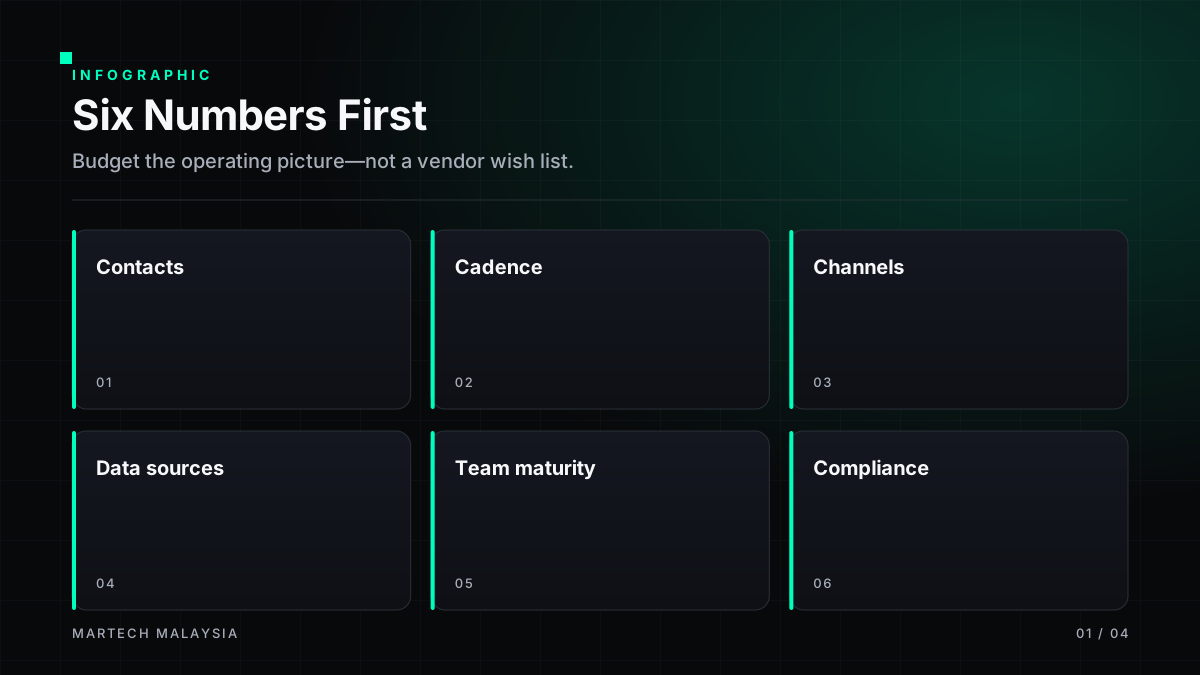
Before any budget conversation, capture six numbers about the business. They drive every downstream decision.
Contacts & monthly active identities
Distinct people you email, message or advertise to in a month. Most MarTech billing is a function of this.
Campaigns & journeys per month
Broadcast sends, triggered journeys, lifecycle programs, sales sequences. Drives ops workload, not licence cost.
Email · SMS · WhatsApp · Push · Ads
Every added channel adds a template system, deliverability surface and consent scope.
Systems producing customer events
Website, app, POS, e-commerce, CRM, support, warehouse. More sources = more integration cost.
Who owns which layer today?
Marketing runs sends. Who owns data model, tracking, consent, deliverability, attribution? If blank — you have an ops gap, not a tool gap.
PDPA, regional data flows, sector rules
Financial services, healthcare and children's products carry additional obligations. See PDPA for Marketers.
Total cost of ownership: what the licence fee hides
Vendor pricing pages advertise the licence. That is typically the smallest line in the first two years. A defensible MarTech budget models six cost layers, not one.
Platform fee. Tiered by contacts, seats, MAU, sends or events. Read the billing basis carefully — one platform's "contact" is another's "profile" is another's "monthly tracked user".
Initial configuration, data model, template system, tracking plan, journey build, sandbox and production separation. Frequently 0.5–1.5× annual licence for a real deployment.
ETL/reverse-ETL, event streaming, CRM sync, warehouse connections, product feeds, consent propagation. Recurring, not one-off.
Deduping, identity stitching, historical import, taxonomy alignment. The line item most often skipped and most often blamed later.
The humans who plan, build, QA, deploy and analyse. Usually the biggest recurring cost after year one.
Enablement, docs, playbooks, vendor premium support, external help when things break. Chronic under-budgeting here creates the "shelfware" narrative.
A stage-based budget frame (planning illustration)
The table below is a planning illustration in MYR for four common growth patterns in Malaysia. Treat these as starting brackets to challenge, not benchmarks to hit. A subscription app with rich event data can outspend a much larger retailer on the same category. Every number below is annual.
| Stage / pattern | Licence layer | Implementation + integration | Ops labour | Planning total (yr 1) |
|---|---|---|---|---|
| Starter · < 20k contacts, 1 channel, spreadsheet-heavy | RM 6k–24k | RM 5k–20k | 0.25–0.5 FTE (internal) | RM 30k–90k |
| Scaling SME · 20k–150k contacts, 2–3 channels, CRM in use | RM 30k–120k | RM 30k–120k | 0.5–1 FTE + fractional consultant | RM 120k–360k |
| Multi-brand / regional · 150k–1M identities, 3–5 channels, warehouse | RM 150k–500k | RM 120k–400k | 2–4 FTE + agency retainer | RM 500k–1.5M |
| Enterprise · > 1M identities, full stack, compliance-regulated | RM 500k–2M+ | RM 400k–1.2M+ | MarTech function (4–10+ FTE) | RM 1.5M–5M+ |
Read this as decision patterns. A ten-person B2B software company selling into enterprise may sit in the "scaling SME" licence bracket while carrying "regional" integration cost because of Salesforce, product-led signals and RevOps requirements. Match the pattern to your operating picture, not your headcount.
Do you actually need a platform, or is a lighter stack enough?
Not every business benefits from a marketing cloud. The below decision flow is the version we run in real engagements.
Do you have < 10,000 contacts, one channel, and no event-driven journeys? A modern email tool (Mailchimp, Brevo, ConvertKit) plus a CRM you already own is usually enough. Spend the money you saved on content and tracking hygiene.
Do you have real event data (product usage, purchases, in-app behaviour)? This is where lightweight tools break. You need a platform with an event API and a journey builder that can subscribe to those events — Customer.io, Klaviyo, HubSpot Marketing Pro/Enterprise, Braze, Iterable, depending on model.
Is sales-and-marketing alignment your bottleneck, not journeys? Start with the CRM (HubSpot Sales, Salesforce Sales Cloud, Pipedrive) and keep marketing light until pipeline hygiene is solved.
Do you have > 3 source systems producing customer data, or multiple brands / regions? Consider a Customer Data Platform or warehouse-native activation before layering another engagement tool on top of messy data.
Are you regulated, multi-country, or handling sensitive data at scale? This is where enterprise suites (Salesforce Marketing Cloud, Adobe, SAP Emarsys, Braze) earn their price — audit trails, permissioning, regional deployments and vendor SLAs.
HubSpot vs Salesforce vs lighter/composable — without the marketing gloss
Both categories can be right. The question is which failure mode you're better equipped to absorb.
| Approach | Wins when | Breaks when | Typical Malaysia bracket (yr 1) |
|---|---|---|---|
| HubSpot (Marketing Hub + CRM) | You want one vendor, fast to deploy, a strong self-serve UX, decent reporting, and predictable behaviour across marketing and sales. | Contact-based billing punishes list growth, deep customisation hits ceilings, and you outgrow reporting once product data becomes central. | RM 60k–450k licence, add ~1× for implementation and enablement. |
| Salesforce (Sales Cloud + MC / Data Cloud) | You already run Sales Cloud, you have complex B2B pipelines, or you need enterprise governance, permissioning, and multi-org data. | Underestimated implementation cost, slow to change, and licence models that require a specialist to price accurately. | RM 200k–1M+ licence, implementation 1–2× licence in year one. |
| Lighter / composable stack (Customer.io or Klaviyo + warehouse + CRM + reverse-ETL) | You have engineering support, real event data, a warehouse in play, and want to avoid vendor lock-in on the data model. | You lack ops discipline; nobody owns the data contracts; you keep shipping new tools instead of maturing the ones you have. | RM 80k–500k licence total, implementation heavily engineering-dependent. |
When to hire a Marketing Operations / MarTech specialist
The tool doesn't fail; the operating model does. Hire (or engage a consultant to install one) when at least three of these signals show up in a quarter:
- Campaigns are shipping late or with QA errors more than once a month.
- Sales, marketing and finance report different numbers for the same metric.
- You maintain more than four platforms daily and reconciliation is manual.
- Nobody can produce a current tracking plan or consent map on request.
- Renewals arrive without a value review; you say yes because switching feels harder than paying.
- You're planning a migration, a re-platform, or a new channel and don't have a documented data model.
In-house Marketing Ops Manager · Agency retainer · Freelance/fractional consultant
Continuity & institutional memory
Best when the workload is steady, tooling is standardised, and knowledge needs to accumulate. Payload: salary, tools, training, redundancy risk if they leave.
Bench, scale, delivery
Best when you need multi-discipline output (design, dev, media, ops) at pace. Payload: markup, priority contention with other clients, less deep product context.
Decisions, architecture, unblocking
Best when the constraint is decision quality, not volume. Sizing the stack, designing the data model, running a migration. See Freelance vs Agency.
Sample annual planning scenarios (illustrative, MYR)
These are worked planning scenarios, not benchmarks. Every line is a plausible allocation for a company matching the pattern; every real budget will diverge.
Scenario 1 · B2B SaaS, 25 staff, RM 8M ARR, HubSpot-led
| Line item | Planning allocation | Note |
|---|---|---|
| HubSpot Marketing Pro + Sales Pro | RM 90k | Growth tier, 5 seats, ~20k contacts |
| Analytics (GA4 + BigQuery + Looker Studio) | RM 12k | Warehouse fees + reporting |
| Chatbot / support | RM 18k | Intercom or equivalent |
| Data governance & tracking retainer | RM 60k | Fractional MOps, 2 days/month |
| Implementation / migration reserve | RM 40k | One migration per year |
| Training & certifications | RM 8k | 2 team members |
| Total year 1 | RM 228k | ~2.85% of ARR |
Scenario 2 · E-commerce, 60 staff, RM 30M revenue, event-driven
| Line item | Planning allocation | Note |
|---|---|---|
| Klaviyo (email + SMS) | RM 90k | ~120k active profiles |
| WhatsApp Business API + BSP | RM 60k | Conversation fees + platform, see WhatsApp for Marketers |
| CDP or reverse-ETL | RM 120k | Segment / RudderStack / Hightouch |
| Warehouse (BigQuery/Snowflake) + BI | RM 40k | Usage-based |
| Attribution & tag management | RM 45k | Server-side GTM, see SSGTM Guide |
| Ops labour (in-house lead + agency retainer) | RM 220k | 1 FTE + agency for design/build |
| Data cleanup + implementation reserve | RM 80k | Identity stitching, historical import |
| Total year 1 | RM 655k | ~2.2% of revenue |
Scenario 3 · Regional multi-brand retail, RM 200M revenue
| Line item | Planning allocation | Note |
|---|---|---|
| Marketing cloud licence (SFMC / Braze / Emarsys) | RM 500k–900k | Depending on volume tier and modules |
| CDP | RM 350k–700k | Enterprise CDP with identity resolution |
| Analytics platform + warehouse | RM 150k | Multi-country data |
| Integration / MarTech engineering | RM 400k | 2 engineers + tools |
| MOps team (in-house) | RM 700k | 3–5 FTE |
| Agency partners (creative, media, dev) | RM 600k | Retainers |
| Training, governance, compliance | RM 80k | PDPA reviews, playbooks |
| Total year 1 | RM 2.8M–3.5M | ~1.4–1.75% of revenue |
Procurement & renewal checklist
Most overspend does not happen at signature. It happens at renewal, when nobody has bandwidth to re-open the file. Run this before every renewal.
- Which usage tier are we actually using? Contacts, MAU, events, seats — pull the last 12 months.
- Which modules were unused for > 60 days? Downgrade or drop before renewal.
- Which integrations are still active, and which have quietly failed?
- What is the true switching cost? Migration hours × loaded ops rate + double-run period + retraining.
- What discount lever has the vendor not used yet? Multi-year? Prepay? Case study? Referral? Bundling with another module?
- Are there any auto-escalation clauses (typically +5–10% on renewal)? Negotiate them out or cap them.
- Have contract owners changed on either side? Reconfirm SLAs and DPA.
- What business outcomes did the platform influence this year? Missing this line is the single biggest reason for eventual churn — from you or from your CFO's patience.
Measuring value realised
MarTech ROI cannot be settled by a single number. Track a small, boring, defensible portfolio instead. See Marketing Automation ROI for the full framework.
Operational
Time to launch a campaign · QA defect rate · % automated vs manual sends · Data freshness SLA.
Financial
Blended CAC · CAC by channel-attributed segment · Repeat purchase rate · LTV/CAC · MarTech spend as % revenue.
Customer
Consent capture rate · Engagement decay curves · Complaint rate · Deliverability & unsubscribe trend.
Risk
PDPA incidents · Vendor SOC 2 / ISO status · Consent-log completeness · Recovery-time objectives for critical journeys.
Frequently asked questions
How much of revenue should we spend on MarTech?
Total marketing spend commonly ranges 6–12% of revenue for growth-stage businesses; MarTech is a subset of that. As an anchor for planning, MarTech ends up 10–30% of the total marketing budget once you account for platforms, integration, tracking and ops labour. Use it as a starting bracket to test, then work back to specifics using the six operating numbers above.
Should we buy HubSpot before Salesforce, or the other way around?
If your primary constraint is sales-and-marketing alignment and speed to deploy, HubSpot's suite is faster to value. If you already run Salesforce Sales Cloud, or you sell into large B2B accounts with complex product/quote logic, Salesforce is usually the anchor and marketing tools plug into it. Neither choice is permanent; both are expensive to reverse.
When is a Customer Data Platform worth the cost?
When you have three or more customer-data sources, more than one activation channel, and existing tools are already installed but not delivering. A CDP does not fix a broken tracking plan; it exposes it. See the Practical CDP Guide.
Is it cheaper to hire in-house or use an agency?
Steady, repeatable workload favours in-house. Bursty, multi-discipline delivery favours an agency. For decision-heavy work (architecture, migration, sizing) neither is cheaper than a good fractional consultant. Compare on total cost, continuity risk and speed to a defensible decision, not day rate.
What's a reasonable MarTech budget for a Malaysian SME just starting out?
For a services or single-brand business with fewer than 20,000 contacts and one primary channel, a defensible year-one planning bracket is RM 30k–90k across licences, implementation and light ops support. If you are running e-commerce with real event data, expect to enter the RM 120k–360k bracket faster than headcount suggests.
How do we avoid the "shelfware" trap?
Only buy a platform when you have named the owner, the first three journeys, the data sources, the QA process, and the renewal review date. If any of those five is blank, you are buying a subscription and hoping for a strategy.
Where to go next
- Comparing engagement models: Freelance MarTech Consultant vs Agency
- Choosing an outside partner: How to Choose a MarTech Consultant in Malaysia
- Selecting a tool: Marketing Automation Tools Shortlist
- Service pages: MarTech Consulting · Digital Roadmap · Data Consulting
Sources & further reading
- HubSpot pricing & product tiers — official product pricing page, hubspot.com/pricing (retrieved 17 July 2026).
- Salesforce Marketing Cloud & Sales Cloud editions — official pricing and product pages, salesforce.com (retrieved 17 July 2026).
- Klaviyo pricing basis — active profile billing documentation, klaviyo.com/pricing (retrieved 17 July 2026).
- Customer.io pricing — customer.io/pricing (retrieved 17 July 2026).
- Personal Data Protection Act 2010 (Malaysia) — Department of Personal Data Protection, pdp.gov.my.
- Gartner CMO Spend Survey — annual marketing spend benchmarks (most recent public release; cited as directional only).
All figures presented in MYR in this article are planning illustrations, not benchmarks. Retrieval date for third-party pricing references: 17 July 2026.