


There is no universal best marketing automation tool for Malaysian SMEs. There is a best fit for your business model, your data, your channels and your team. This vendor-neutral shortlist walks through the decision by scenario, not by feature list, and shows where the hidden costs actually sit. Read it with the budgeting pillar and Marketing Automation ROI.
Key takeaways
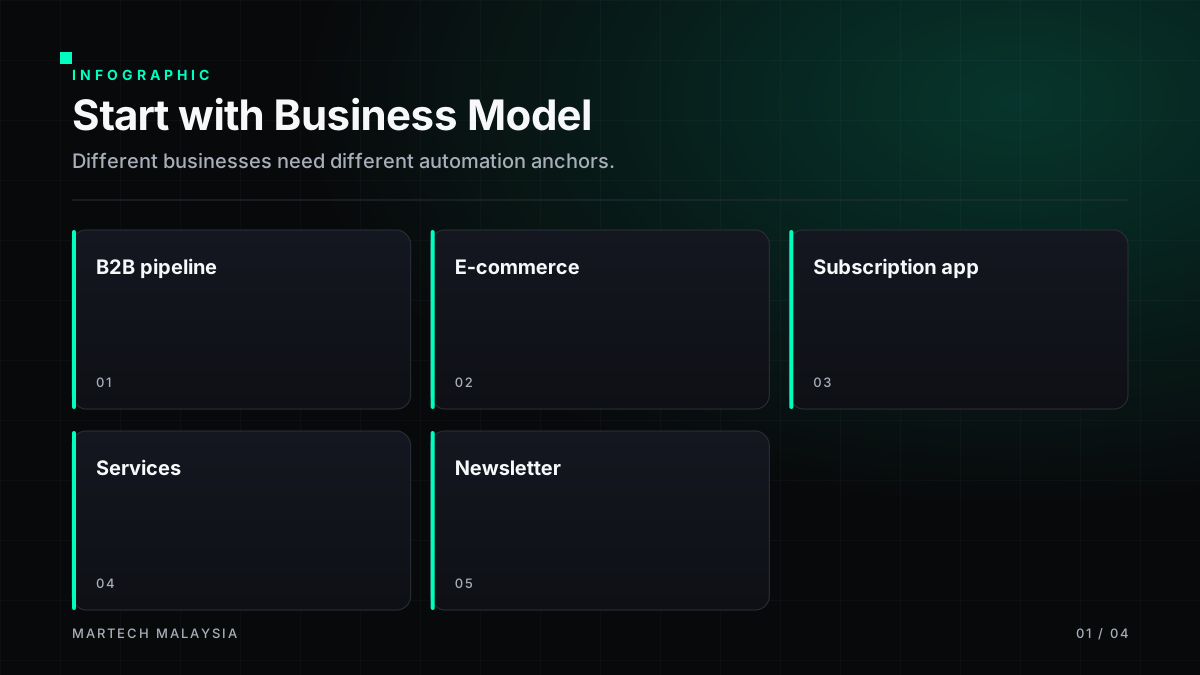
- Decide by business model first — B2B pipeline, e-commerce, subscription/app, services, basic newsletter — not by tool.
- Billing basis matters more than sticker price. "Contacts" ≠ "profiles" ≠ "monthly tracked users" ≠ "events."
- Exit cost, data model rigidity and lock-in on identity are the three most under-estimated costs.
- Prefer a lighter stack when your event data is thin, your team is small, or your operating model isn't yet stable.
- All pricing figures below reference structure, not a promise; verify at the vendor's official page. Retrieval date noted throughout.
Step 1 · Decide by business model
Every real shortlist starts here. Skip this step and you'll be comparing tools that were designed for different jobs.
B2B pipeline (deals, quotes, long cycles). The CRM is the anchor; marketing tool is secondary. Shortlist: HubSpot Marketing Hub Pro/Enterprise (paired with HubSpot or Salesforce CRM), ActiveCampaign for smaller B2B, or Marketo/Salesforce Marketing Cloud Account Engagement for larger ones.
E-commerce (transactions, product feed, retention). Klaviyo is the incumbent choice; Omnisend and Brevo compete for smaller catalogues; Customer.io or Braze for larger operations with app/product data.
Subscription / app (product events, lifecycle stages). Customer.io, Braze, and Iterable are built for event-driven journeys. HubSpot Marketing Enterprise can play here but not natively on product events.
Services / consultancy (relationship-led). Light CRM + light email is usually enough. HubSpot Starter, Pipedrive, Zoho, or even Google Workspace + Brevo/Mailchimp. Don't over-buy.
Basic newsletter + transactional messaging. Brevo, Mailchimp, ConvertKit, or a transactional-first option like Resend paired with a light marketing tool. Cheapest path to "grown up" without complexity.
Step 2 · The selection criteria that actually predict success
What is a "unit"?
Contacts, profiles, MAU, events, seats, sends. Each vendor's definition affects your cost curve differently as you grow.
Can it consume real events?
If yes: API, event schema, throughput limits, retention. If no: you'll be locked to form-fill segmentation.
Deliverability & templating
Send infrastructure, dedicated IP options, template system, dynamic content, testing tools.
Native or integrated?
Malaysia leans heavily on WhatsApp. Native support, BSP flexibility and cost transparency matter. See WhatsApp for Marketers.
Branching, waits, exits
Visual builder, real-time triggers, journey inspector, entry/exit rules, batch vs streaming behaviour.
How tightly coupled?
Same platform vs sync? Bi-directional? Which fields, in what latency?
What can you actually report on?
Native reporting quality; ability to export to your warehouse. See Marketing Attribution.
Openness
REST/streaming APIs, rate limits, webhook reliability, event replay.
Where does data live?
Region hosting, cross-border transfer basis under PDPA, DPA templates.
Timezone & escalation
Regional support hours, SLAs, incident processes.
Weeks to first value
Native templates & onboarding vs deep configuration.
How hard to leave?
Export completeness, identity portability, template portability, historical event export.
Step 3 · Shortlists by scenario
Each shortlist below is a starting point for a shortlist, not a ranking. Positioning drawn from each vendor's public documentation (retrieved 17 July 2026).
Scenario A · Malaysian B2B SME, 10–75 staff, deal-led pipeline
| Tool | Why it fits | Where it breaks | Billing basis |
|---|---|---|---|
| HubSpot Marketing Hub Pro + Sales Hub Pro | Single vendor for marketing + CRM, fast to deploy, decent reporting, strong self-serve UX. Sales & marketing on the same object model. | Contact-based billing punishes list growth; deep customisation hits ceilings; product-data workflows are limited. | Marketing contacts; seats for sales. |
| ActiveCampaign | Strong automation builder at SME price; email + CRM in one; useful for lifecycle without a marketing cloud budget. | Reporting depth and enterprise governance are thinner than HubSpot; less mature product-event support. | Contact + feature tier. |
| Salesforce Sales Cloud + Marketing Cloud Account Engagement | Where enterprise B2B pipelines already run, or when you sell into large accounts with complex quote/order flows. | Implementation heavy; licence complexity; total cost typically 2–3× smaller HubSpot equivalents. | Multiple SKUs; specialist-priced. |
Scenario B · Malaysian e-commerce, single or multi-brand
| Tool | Why it fits | Where it breaks | Billing basis |
|---|---|---|---|
| Klaviyo | Purpose-built for commerce (Shopify/WooCommerce/Salesforce Commerce). Strong flows, segmentation, revenue attribution and SMS. Native WhatsApp integrations via partners. | Active-profile pricing scales quickly with list growth; reliance on product feed quality; not a general-purpose marketing platform. | Active profiles + channels (email, SMS). |
| Omnisend | Cheaper alternative for smaller catalogues, similar commerce-centric flows and SMS. | Less mature analytics and enterprise governance. | Contacts + sends. |
| Brevo (formerly Sendinblue) | Cost-effective, EU-anchored, includes SMS and WhatsApp. Good for smaller SEA brands with cost pressure. | Advanced segmentation and journey depth less powerful than Klaviyo/Customer.io. | Send-based, not contact-based. |
| Customer.io | When product data / app data are central and email/SMS/push must all sit on the same events. | Requires engineering to feed events reliably; not a plug-and-play e-commerce tool. | Profiles + workspaces; separate transactional module. |
Scenario C · Subscription / app / product-led SaaS
| Tool | Why it fits | Where it breaks | Billing basis |
|---|---|---|---|
| Customer.io | Event-first architecture. Fine-grained journey control. Reasonable pricing for smaller teams. Good API and webhook maturity. | Reporting is functional, not exhaustive; you'll likely export to a warehouse. | Profiles; separate transactional; enterprise tier for advanced modules. |
| Braze | Enterprise-grade, real-time cross-channel (email, push, in-app, SMS, WhatsApp). Strong at scale. | Enterprise contract model; implementation cost non-trivial; over-buy risk for early-stage teams. | MAU + channel-based. |
| Iterable | Balanced between Customer.io flexibility and Braze scale; strong lifecycle modelling. | Pricing and implementation typically enterprise-shaped. | Contacts + modules. |
Scenario D · Services / consultancy / relationship-led
| Tool | Why it fits | Where it breaks | Billing basis |
|---|---|---|---|
| HubSpot Starter | Enough CRM, email and forms for a services business; fast to adopt. | Journeys are basic; growth pushes you to Pro tier quickly. | Seats + marketing contacts. |
| Pipedrive / Zoho + Brevo or Mailchimp | Cheaper composite for small teams comfortable with two tools. | Two products to manage; less unified reporting. | Per-user + email tier. |
Scenario E · Newsletter + transactional
| Tool | Why it fits | Where it breaks | Billing basis |
|---|---|---|---|
| Brevo | Send-based pricing suits lists that don't broadcast frequently; includes transactional and WhatsApp. | Not a marketing automation platform for complex journeys. | Send + module tier. |
| Mailchimp | Familiar, quick to onboard, good templates. | Contact-based billing gets expensive as lists grow; automation depth is limited compared with peers. | Contacts + tier. |
| ConvertKit | Creator-friendly, clean automations, strong deliverability reputation. | Not built for e-commerce or product events. | Subscribers + tier. |
| Resend + light marketing tool | Developer-first transactional email + a small marketing tool. Modern APIs and deliverability posture. | Requires engineering; not a full marketing suite alone. | Send-based. |
Step 4 · Capability comparison matrix (directional)
This matrix is directional and drawn from each vendor's public documentation as at 17 July 2026. Positioning changes frequently; verify current capabilities before purchase.
| Capability | HubSpot | ActiveCampaign | Brevo | Klaviyo | Customer.io | Salesforce MC |
|---|---|---|---|---|---|---|
| Native CRM | Yes | Light CRM included | Light CRM | No (integrations) | No (integrations) | Via Sales Cloud |
| E-commerce depth | Moderate | Moderate | Basic | Deep | Moderate (event-driven) | Deep (with add-ons) |
| Real-time event journeys | Enterprise tier | Moderate | Basic | Strong | Strong (event-first) | Strong |
| WhatsApp support | Via integrations | Via integrations | Native (via BSP) | Native (via BSP) | Via integrations | Native |
| SMS support | Yes (regions vary) | Yes (regions vary) | Yes | Yes | Yes (via provider) | Yes |
| API depth | Broad | Moderate | Moderate | Broad | Strong | Very broad |
| Warehouse export | Available (Enterprise) | Available | Basic | Available | Available | Available (Data Cloud) |
| Implementation effort | Low–moderate | Low–moderate | Low | Moderate | Moderate–high | High |
| Typical yr-1 licence (SME planning) | RM 60k–200k | RM 20k–90k | RM 10k–60k | RM 40k–200k | RM 40k–160k | RM 250k+ |
Reading the pricing column. These brackets are planning illustrations only. Every vendor prices on a distinct basis (contacts/profiles/MAU/sends). A 50k-contact retailer on Klaviyo can be cheaper or more expensive than the same list on HubSpot depending on activity and channels enabled. Verify at the official pricing page and read the billing basis carefully.
Step 5 · Hidden cost & lock-in checklist
Sticker price is rarely where you get hurt. These are the layers to inspect before you sign.
Is it linear with growth, or does it step? What is the definition of a "contact" or "profile"? Does the vendor bill for suppressed / unsubscribed contacts?
Are SMS, WhatsApp, transactional email, dedicated IP, sandbox, or advanced analytics separate SKUs?
Onboarding fees, professional services, mandatory certified partners for enterprise SKUs.
Regional hosting, transfer basis under PDPA, DPA and sub-processor list. Migration to a different region is not free.
How is a customer identified? Are you locked into the vendor's identity graph, or can you feed and read the same ID everywhere?
Can you export your event history and message history if you leave? In what format?
Renewal price increases baked into the contract. Negotiate a cap.
Every tool needs someone to run it. See the budgeting pillar.
Step 6 · Questions to answer before demos
- Who are the primary users, and what do they do daily?
- What is our source of truth for the customer profile?
- Which events do we actually have, reliably, today?
- Which channels will we run in the first 6 months? The next 12?
- What is our consent model, and how does it survive tool changes?
- What must we report on, and to whom?
- Which integrations are non-negotiable in month 1?
- Who will own QA, deliverability and incident response?
- What is our exit strategy if this vendor is wrong in 24 months?
Step 7 · Implementation readiness
Even the right platform will underperform if these are missing before implementation begins:
- A tracking plan with owners and QA checks.
- A data model with customer, order/subscription and product entities named.
- An identity resolution strategy that survives multiple channels.
- Consent state captured as a first-class attribute across sources.
- Named ops owner and a written runbook for the first three journeys.
- Baseline metrics captured before change, so value realisation is measurable.
When a lighter stack is better than an all-in-one suite
Prefer lighter when…
Small team, single or two channels, list under 30k, no product event data, cost sensitivity, or a business model still in flux.
Prefer all-in-one when…
Sales + marketing alignment is the constraint, cross-team reporting matters, you'd rather trade optimisation for coherence, and buyer expects one vendor to answer for the whole stack.
Frequently asked questions
Is HubSpot worth it for a Malaysian SME under 50 staff?
For B2B or services with sales-and-marketing alignment as the primary constraint, HubSpot Starter or Pro is often the fastest path to a coherent system. For e-commerce or product-led businesses, HubSpot is usually not the best-fit anchor tool.
How do we choose between Klaviyo and Customer.io?
If your growth engine is commerce (product catalogue, transactions, retention flows), Klaviyo is purpose-built and the shorter path. If your growth engine is product engagement (subscription, app, feature adoption) and you have engineering support, Customer.io's event-first model fits better.
What about WhatsApp? Do we buy it as a module or use a separate BSP?
Both are viable. Bundled modules are simpler to procure and govern; separate BSPs offer more flexibility on conversation pricing and templates. See WhatsApp Business API for Malaysian Marketers.
Should we worry about data residency under PDPA?
Yes. Personal data leaving Malaysia must have a proper legal basis. Check where your candidate platform hosts data, what its cross-border transfer position is, and whether the DPA reflects the Malaysian regime. Not a deal-breaker for most global platforms, but it must be documented. See PDPA for Marketers.
Can we start on one tool and re-platform later?
Yes, but not for free. Historical event data rarely migrates cleanly, and templates and journeys are usually rebuilt from scratch. Design your identity model and consent model to be portable so at least the customer graph survives a switch.
What if we already have Salesforce or HubSpot in the business, but for sales only?
Start there. Marketing tooling that sits close to the CRM in use has a very different ROI curve than one that requires new integration and change management.
What if none of these fit?
Then the question is likely not "which marketing automation tool" but "which data problem am I solving?" Consider a CDP-led architecture or warehouse-native activation, and let a lighter engagement tool sit downstream.
Where to go next
- Planning the spend: MarTech Budgeting, Hiring & Tool Selection
- Measuring the payoff: Marketing Automation ROI
- Choosing a partner: How to Choose a MarTech Consultant
- Comparing engagement models: Freelance vs Agency vs In-House
- Service pages: Marketing Automation · Automation Expertise · Data Consulting
Sources & further reading
- HubSpot — official pricing and product tiers, hubspot.com/pricing (retrieved 17 July 2026).
- ActiveCampaign — pricing page, activecampaign.com/pricing (retrieved 17 July 2026).
- Brevo — pricing page, brevo.com/pricing (retrieved 17 July 2026).
- Klaviyo — active profile pricing basis, klaviyo.com/pricing (retrieved 17 July 2026).
- Customer.io — plans and modules, customer.io/pricing (retrieved 17 July 2026).
- Salesforce Marketing Cloud — editions overview, salesforce.com (retrieved 17 July 2026).
- Personal Data Protection Act 2010 (Malaysia) — Department of Personal Data Protection, pdp.gov.my.
Vendor positioning changes; verify at official sources. MYR figures are planning illustrations. Retrieval date: 17 July 2026.