


Freelance MarTech consultant, marketing agency, or in-house Marketing Operations hire — which one actually solves your problem? Day rate is the wrong axis. The real question is what kind of failure you can afford: slow decisions, thin bench, weak continuity, or high fixed cost. This guide is a decision framework, not a sales pitch, and it links directly to the budgeting pillar and consultant-selection guide.
Key takeaways
- Freelance consultants win on decision quality, speed to a defensible answer, and specialist depth. They lose on bench and continuity.
- Agencies win on multi-discipline output at scale. They lose on deep product context and often on senior time-on-account after month three.
- In-house wins on continuity and institutional memory. It loses if the workload is bursty or the required skill is rare and expensive.
- The three highest-risk moments are: initial platform selection, migration, and any project where "the vendor said we could just switch it on."
- Compare on total cost of engagement (fees + your time + risk of a bad decision), never on day rate.
The five dimensions that actually matter
Before comparing options, agree with your team on how you weigh these. Different weightings produce different right answers.
Who owns the outcome?
A named senior operator with skin in the outcome, or a rotating team where continuity depends on internal briefings you write.
Depth behind the lead
Can they scale up designers, developers, ops, media buyers, and analysts when the project needs it?
Deep vs broad
Do you need a MarTech architect who has migrated Salesforce Marketing Cloud four times, or a generalist who can also do content and paid?
Institutional memory
Who remembers why decisions were made, six months in? Documentation habits > personalities here.
Time to first defensible answer
Vendor-onboarding, SOW cycles and internal approvals can add weeks. If a decision is blocking revenue, that time is real cost.
Fixed vs variable
FTE = fixed. Agency = high variable, hard to turn off mid-year. Freelance = variable, ceiling on capacity.
Comparison matrix: freelance vs agency vs in-house
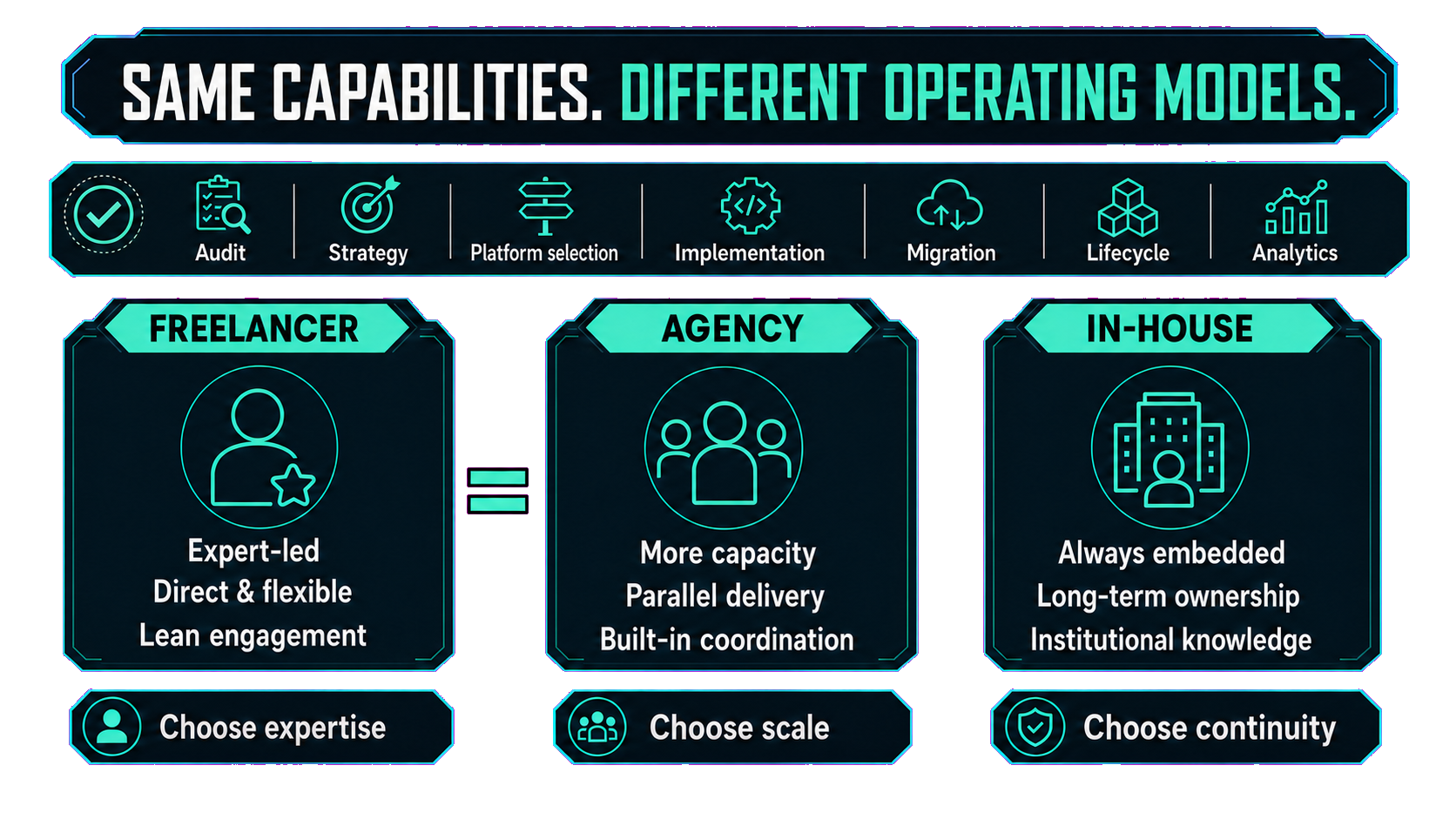
The matrix below is directional. A senior boutique agency can outperform a mid-level freelancer, and vice-versa. Use it as a diagnostic, not a scoreboard.
| Dimension | Freelance / fractional consultant | Agency (retainer or project) | In-house hire |
|---|---|---|---|
| Best for | Decisions, architecture, unblocking, senior review, focused implementation | Multi-discipline delivery at pace and volume | Steady, repeatable ops workload; long-term ownership |
| Time to start | Days to two weeks | Two to eight weeks (SOW, procurement) | Two to six months (search + notice + ramp) |
| Continuity risk | High if solo (illness, capacity) | Medium (team rotation, senior time drops) | Low, until they resign — then very high |
| Bench & scalability | Limited; usually 1–2 people | High; can flex across disciplines | Fixed to the roles you've hired |
| Depth in one platform | Very high (that is the value proposition) | Variable; often deep in 1–2, thin in others | Grows over time if scoped and supported |
| Institutional memory | External; depends on documentation habits | External; team rotation erodes it | Internal, compounding — the main structural advantage |
| Cost structure | Variable, project or retainer | Retainer or project; markup on juniors | Salary + benefits + tools + management overhead |
| Fit for compliance-heavy work | Excellent if named specialist | Depends on the agency's assurance posture | Best long-term; requires investment in training |
| Common failure mode | Single-threading; bus-factor of one | Senior sold, juniors delivered | Wrong hire, or right hire under-supported |
Project-type fit: match the engagement to the work
Some kinds of work do not care what your org chart looks like — they only care whether the right operator is in the room. Others are the exact opposite.
MarTech audit or stack review. Freelance consultant (1–3 weeks). Bench is not the constraint; independent judgement is. An audit delivered by the same partner who will implement the recommendations has a well-known conflict.
Platform selection / vendor evaluation. Freelance consultant or a boutique with no reseller relationships. Ask directly about referral fees. Ask again in writing.
Implementation (new platform). Agency or vendor-certified partner if the work is large and multi-discipline; freelance lead architect + agency delivery if you want independent oversight.
Migration between platforms. Freelance architect for the plan and data model; agency or in-house for execution; a joint gate-review structure. Migrations fail on planning, not tooling.
Lifecycle / journey build. Agency retainer if you need volume (multiple journeys, creative, ops), in-house if the journeys are stable and yours forever, freelance if you need one senior person to design the operating model.
Analytics / attribution. Specialist freelancer for design (tracking plan, attribution model), agency or in-house for maintenance and reporting.
Ongoing managed operations. In-house first if workload is stable; agency retainer to fill specific gaps (deliverability, WhatsApp ops, media). Freelance is the wrong shape for 12-month steady-state ops.
Realistic engagement structures
Fixed-scope project
Best for audits, migrations, launches. Requires a tight statement of work, acceptance criteria and a change-order process. Watch scope creep; it eats margin on both sides.
Retainer (monthly hours)
Best for ongoing operations, coaching, or steady advisory. Cap hours, review monthly, define what happens with unused time.
Time-and-materials with cap
Best when scope is genuinely uncertain (data discovery, complex migrations). Cap the risk on both sides; require weekly burn reporting.
Outcome-based (partial)
Attractive on paper, rarely clean in practice. Only workable when the outcome is measurable, controllable and free of third-party dependencies.
Managed service
Agency runs a discipline (deliverability, tag management, media ops). Sensible when your team lacks the specialism and you can afford variable cost.
Embedded / fractional CMO or MOps
Freelance operator inside the business for a defined period. Powerful for scaling teams; requires access to systems and stakeholders.
Red flags — for all three options
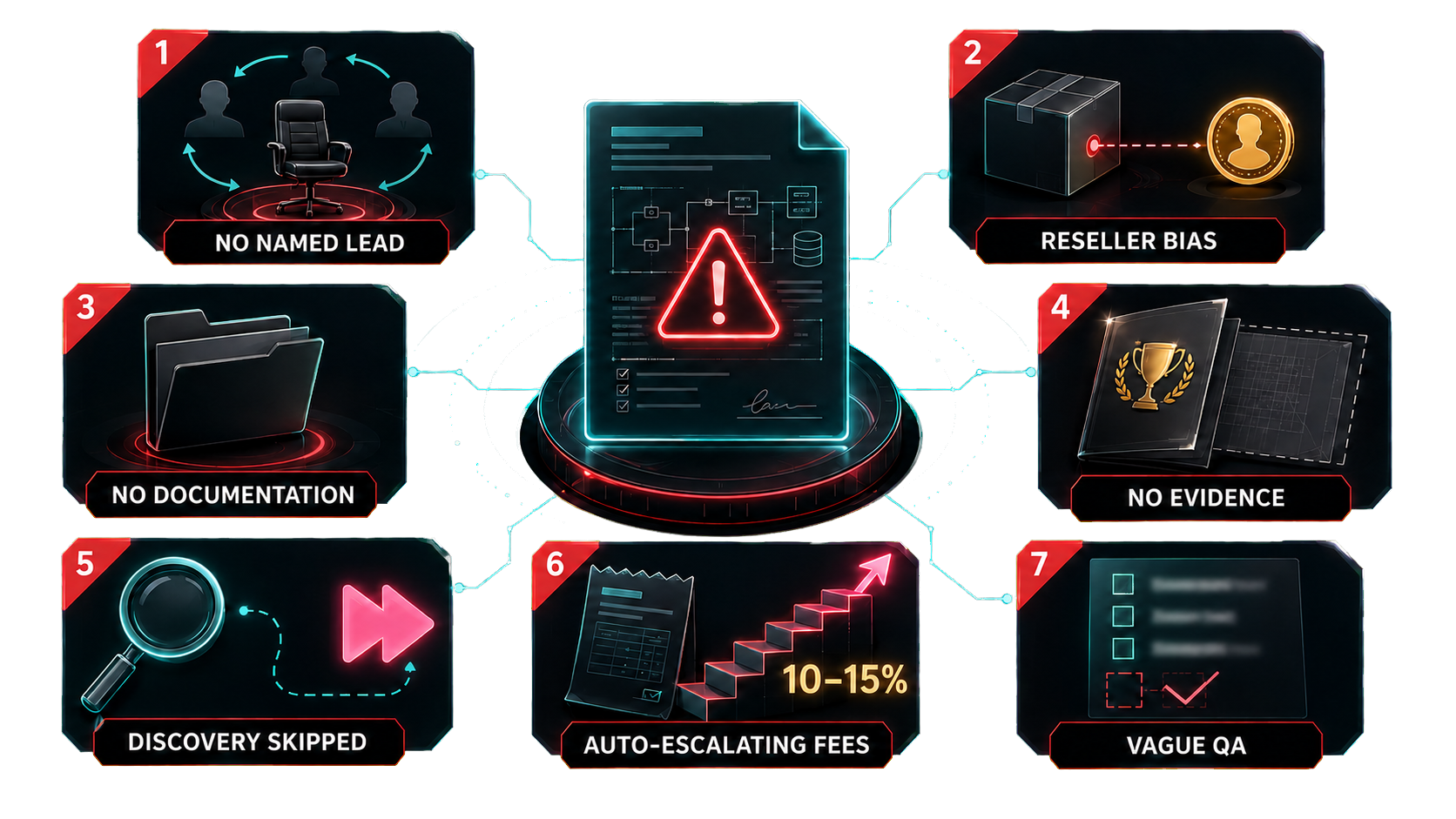
- No named lead. "A team will be assigned" is not accountability.
- Reseller-only revenue model. If the partner only earns when you buy Vendor X, the recommendation was made before you called.
- No documentation deliverables. If nothing survives the engagement in writing, you have rented brains, not built capability.
- Case studies without evidence. Ask for the tracking plan, the data model, the migration runbook — not the case study PDF.
- Discovery skipped. Any partner willing to quote a full implementation without at least a paid discovery is either bluffing or planning to bill the discovery later.
- Auto-escalating retainers. Retainers that raise 10–15% at renewal, without a value review, are the fastest way to overspend.
- Vague QA / acceptance. "We'll know it's done when it feels done" is not a completion criterion.
Total cost of engagement, not day rate
Compare the fully-loaded cost of getting to a defensible decision or outcome, including your team's time, risk-adjusted for the cost of a bad decision. A short worked example, illustrative:
| Scenario | Freelance consultant | Agency retainer | In-house MOps hire |
|---|---|---|---|
| Fee / salary (12 months) | RM 180k (2 days/week, 6 months) | RM 360k (RM 30k/month, 12 months) | RM 180k salary + RM 45k on-cost |
| Internal time cost | 0.2 FTE oversight (~ RM 30k) | 0.3 FTE oversight (~ RM 45k) | 0.15 FTE management (~ RM 22k) |
| Time to first defensible answer | 2–4 weeks | 4–8 weeks | 3–5 months (post-hire) |
| Continuity beyond engagement | Depends on documentation | Depends on team stability | Full, until attrition |
| Risk of bad decision (subjective) | Low if right specialist | Medium; senior time drops post-sale | Medium; new hire ramp |
Illustrative only. Real quotes vary heavily by scope and seniority; use the shape of the comparison, not the numbers.
Scenarios for the Malaysian market
Freelance-led + light agency
Freelance consultant designs the stack and the operating model; a smaller agency handles execution. Keeps senior time on-account, keeps procurement simple.
Hybrid: in-house lead + fractional + agency
Hire a MOps lead; retain a fractional consultant for architecture and unblocking; use agency for creative/media/dev. The consultant protects continuity between team changes.
In-house function + specialist partners
Build the MarTech function internally. Contract specialist partners (migration, deliverability, tag management) with clear boundaries and named specialists, not brand names.
Questions to ask before signing
- Who is the named senior operator on this engagement, and what percentage of their time is contracted to us?
- Show me the last three deliverables of the same type. Not the case study — the artefacts: tracking plan, data model, migration runbook, journey map.
- What is your relationship with the platforms you'll recommend? Do you receive referral commissions or partner tier benefits?
- How do we know a phase is complete? What are the acceptance criteria?
- What handover artefacts do we own at the end?
- What is the change-order process, and what triggers it?
- Who covers rework if a deliverable fails acceptance?
- What happens if the named lead becomes unavailable?
- What's your policy on our data? Where does it live during the engagement?
- How will we measure whether this engagement was worth it in 12 months?
Frequently asked questions
Is a freelance consultant always cheaper than an agency?
On day rate, often yes; on total engagement cost, not necessarily. A freelance senior costs less per hour but has capacity limits. If you need 500 hours of multi-discipline work in a quarter, an agency's blended team is usually more cost-effective than trying to load that work onto one person.
Can we start with a freelance consultant and move to an agency?
Yes, and it's often the safest sequencing. Use a consultant to define the architecture, the operating model and the specifications. Bring in an agency to execute against those specifications. The consultant can stay on for oversight; the agency handles delivery.
When should we hire in-house instead of extending a retainer?
When the workload is steady, when the accumulated context has real value, and when you can afford a fixed cost. As a rough test: if you're paying an agency more than roughly RM 25k/month for 12 months for the same discipline, model the in-house option seriously.
How do we protect ourselves from the "senior sold, juniors delivered" pattern?
Write the named senior operator into the SOW with a minimum committed time on-account (for example, "Consultant X for a minimum of 40% of engagement hours"). Track it in weekly status. Escalate the moment it slips.
What if we already have Salesforce or HubSpot certified partners on retainer?
Vendor-certified partners have real value on implementation and support, and a real conflict on selection and re-platforming. Use them for what they are good at; use independent advisors for architecture, migration decisions and value-realisation reviews.
How do we know if we need one senior person or a team?
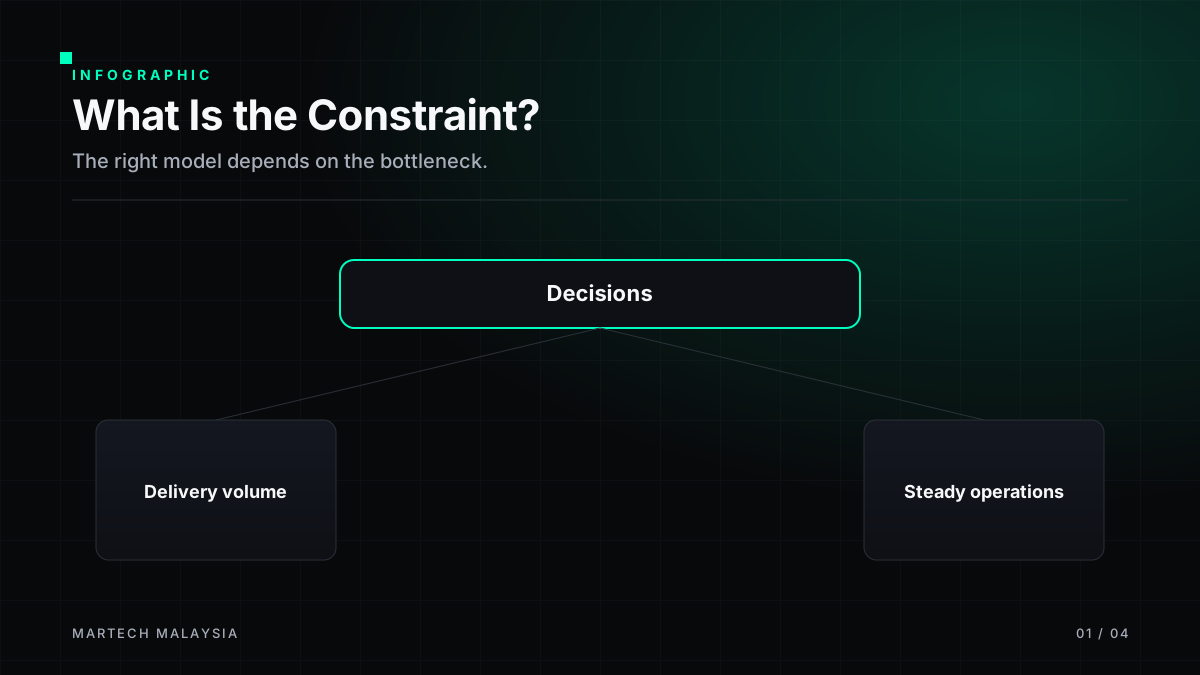
Ask what the constraint is: decisions or delivery. If nobody has decided what to build, you need decisions — one senior operator. If the decision is made and the queue is long, you need delivery — a team.
Where to go next
- Planning the spend: MarTech Budgeting, Hiring & Tool Selection
- Choosing an outside partner: How to Choose a MarTech Consultant in Malaysia
- Selecting a tool: Marketing Automation Tools Shortlist
- Service pages: MarTech Consulting · Marketing Automation
Sources & further reading
- HubSpot Solutions Partner Program — partner tiers and eligibility, hubspot.com/partners (retrieved 17 July 2026).
- Salesforce Partner Program — consulting partner tiers and requirements, partners.salesforce.com (retrieved 17 July 2026).
- Standards for MarTech engagements — MACH Alliance and IAB Tech Lab published materials on composable stacks and vendor evaluation.
- Personal Data Protection Act 2010 (Malaysia) — Department of Personal Data Protection, pdp.gov.my.
Costs quoted in MYR are planning illustrations, not benchmarks. Retrieval date for third-party references: 17 July 2026.