


How do you choose a marketing technology consultant in Malaysia? Shortlist people who diagnose your operating model before recommending a tool, ask for the artefacts they have actually built (tracking plans, data models, migration runbooks), score them on strategy depth, hands-on capability, governance discipline and independence from vendors, and run a paid discovery before committing to a full engagement. Everything below is the working framework we use with Malaysian buyers and the questions to bring to your shortlist.
Key takeaways
- Buy diagnosis before delivery. A credible consultant maps your data, tracking, consent and reporting before naming a platform.
- Ask for evidence, not case studies: redacted tracking plans, data dictionaries, migration runbooks, journey maps, QA checklists and governance policies.
- Score candidates on seven weighted dimensions and use eight structured interview questions to test what each is willing to say out loud.
- Malaysian context matters: PDPA awareness, cross-border data flows, WhatsApp/BSP realities, local and regional stakeholder coordination, and MYR-denominated procurement all belong in the scope.
- Pay for discovery. Free discovery is a sales stage; paid discovery is a deliverable you own.
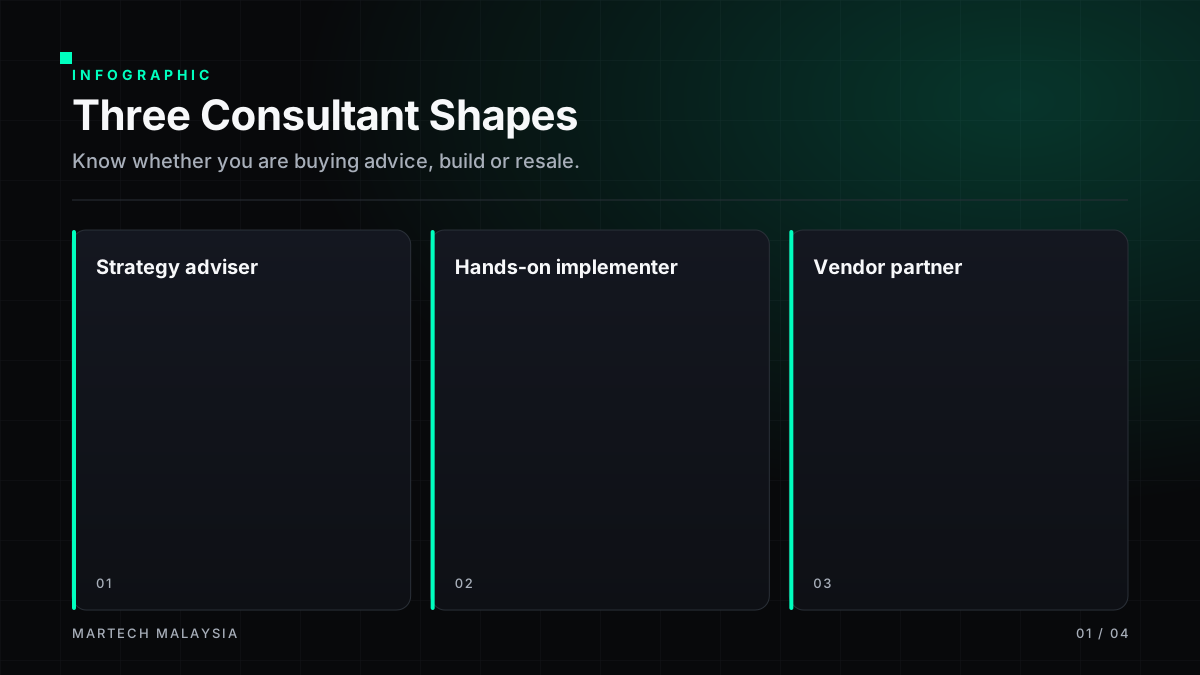
Three shapes of "MarTech consultant" — decide which one you actually need
The label covers three very different jobs. Confusing them is the most common way buyers end up disappointed.
Slides, roadmaps, business cases
Frames the problem, sizes the opportunity, sequences the roadmap. Rarely hands-on inside your platforms. Useful when the constraint is decision quality and execution capacity already exists. Risk: great deck, nothing built.
Architect & builder
Designs and configures the data model, tracking, journeys, integrations, QA and enablement. Value when the problem is execution quality. Risk: loses altitude on strategy; can become a very expensive pair of hands.
Certified & commissioned
Certified on one or more platforms and paid on partner tier or referral. Often excellent at implementation on that platform, structurally conflicted on selection and re-platforming. Not disqualifying — but the conflict must be disclosed and priced in.
A useful shortlist often combines two shapes: an independent adviser to design and govern, plus an implementer (in-house, agency, or a certified partner) to build. Watch the case where a single vendor offers you all three shapes wrapped together — the incentive to stay independent quietly disappears.
What a credible consultant should actually diagnose and deliver
Before comparing quotes, agree on what you are buying. A credible MarTech engagement produces a specific, transferable set of artefacts. If a partner cannot describe how they would build each of these, they are selling something else.
Target-state architecture
A written recommendation for the stack — sources of truth, systems of engagement, warehouse/CDP position, integration pattern — with alternatives considered and trade-offs named. Not a vendor list; a system.
Tracking plan
Event names, properties, triggers, owners, QA checks and platform destinations. The document your engineers can actually implement against. See Server-Side GTM guide.
Identity & data model
Customer object, key entities (order/subscription/product/consent), identity resolution rules across web, app, POS, CRM, and messaging channels. This is where lock-in and portability are decided.
Integration & migration plan
Sequencing, freeze windows, dual-run periods, historical data strategy, cut-over criteria, rollback triggers. Migrations fail on planning, not tooling.
QA & release process
Written checklists for every journey and campaign: seed lists, deliverability, consent state, personalisation fallback, unsubscribe path, throttling and rate limits.
Governance
Ownership map (RACI), review cadences, incident playbook, consent audit, renewal review. Governance is where MarTech quietly succeeds or fails.
Enablement & handover
Playbooks, runbooks, recorded walkthroughs, sandbox exercises and a defined training plan. If your team knows less at the end than at the start, you overpaid.
Measurement
A small portfolio of operational, financial, customer and risk metrics with baselines set before work starts, so value realisation is provable a year later.
Evidence to request — before you scope, not after
Case studies are marketing collateral. The single best predictor of a good engagement is what a consultant has actually built. Ask each shortlisted candidate to share redacted samples of:
- Architecture decision record — a written recommendation with alternatives, trade-offs and a sign-off line, not a slide.
- Tracking plan — with owners, QA checks, and destinations.
- Data dictionary — customer object and key entity definitions.
- Migration runbook — sequencing, freeze windows, dual-run, cut-over, rollback.
- QA checklist — what gets tested before go-live, and by whom.
- Governance policy — ownership, review cadence, incident response, consent audit.
- Enablement material — training deck, playbook, or run-through recording.
- Outcome measurement — baseline, target, observed, and methodology.
Evaluation scorecard (editorial framework)
Score each shortlisted candidate on the same seven dimensions and adjust the weighting to reflect your context — a regulated business should weight governance and PDPA fluency higher; a fast-moving retailer should weight hands-on capability and speed higher. The percentages below are an editorial framework, not an industry standard.
| Strategic depth | Frames the problem in your business language, not tool language. Offers alternatives with named trade-offs. | 15% | — |
| Hands-on capability | Can produce, or supervise producing, the artefacts above. Shares redacted examples on request. | 20% | — |
| Evidence of shipped work | Refers by name to systems they built, sizes they operated at, and problems they hit. | 15% | — |
| Governance discipline | Talks about ownership, cadences, incidents and renewal reviews without being prompted. | 10% | — |
| PDPA & regional fluency | Comfortable with Malaysia's PDPA obligations at a working level; treats consent as a first-class data attribute (details in the PDPA playbook). | 10% | — |
| Independence & disclosure | Volunteers vendor relationships, partner tiers and referral economics without being asked twice. | 15% | — |
| Delivery discipline | Named senior lead, acceptance criteria, change-order process, weekly status habits. | 15% | — |
Weightings are editorial defaults from our engagements — adjust them to your context. A weighted total < 3.5 is usually a signal to add another candidate to the shortlist rather than accept the strongest of a weak field.
Eight interview questions (with strong and weak answer signals)
1. Walk me through the last MarTech engagement you led. Where did it hurt?
Strong signal: Names the platform, the size of the data model, the stakeholder friction, and something they'd do differently. Owns mistakes.
Weak signal: A polished success story with no discomfort in it. That is a case study, not an answer.
2. How would you approach a first diagnostic for our business?
Strong signal: Describes a paid discovery with named deliverables (audit report, target-state options, sequenced roadmap, planning budget). Asks clarifying questions about your stack, data and stakeholders.
Weak signal: Offers a free proposal without seeing anything, or fixes a price for full implementation before diagnosis.
3. Which vendors do you receive referral fees or partner benefits from, and how much?
Strong signal: Discloses specific platforms and partner tiers, and offers to step back from any decision where the conflict is material.
Weak signal: Vague statements ("we're technology-agnostic") without disclosing partner relationships that are visible on the vendor's public partner directory.
4. Show me a tracking plan or data model you have written.
Strong signal: A redacted document, walked through with confidence. Explains event vs property, entity relationships, identity resolution.
Weak signal: "We can share that after signing" for a document that already exists. Signals a scarcity of real artefacts.
5. Describe your runbook for a platform migration you have led.
Strong signal: Talks about freeze windows, dual-run, historical data strategy, rollback triggers, and cut-over criteria. Names the platform and the size.
Weak signal: Generalities — "we do it carefully" — without artefacts or examples.
6. How would you model consent under PDPA for a business with online, WhatsApp and offline touchpoints?
Strong signal: Discusses purpose specification, consent capture per channel, consent state as a first-class data attribute, withdrawal handling and audit logs. Refers to the PDPA playbook or equivalent working guidance rather than reciting the statute.
Weak signal: Reduces PDPA to "an opt-in checkbox." That will not survive a real audit.
7. What acceptance criteria would you propose for a stack implementation?
Strong signal: Concrete criteria — data model deployed and populated, N journeys live, tracking events firing at Y% completeness, dashboards refreshing on a schedule, runbook handed over, team trained.
Weak signal: "The system is live." That is a delivery status, not acceptance.
8. How will we know in 12 months that this engagement was worth it?
Strong signal: Proposes a small portfolio of measures set at kick-off — operational, financial, customer and risk — with baselines captured before work starts.
Weak signal: Points at a marketing-attributed revenue number that they will not control end-to-end.
Red flags & conflicts of interest
- Recommendation before diagnosis. "You need HubSpot" in meeting one.
- Undisclosed reseller economics. Discovered on the invoice, not in the pitch.
- No documentation deliverables. Everything lives in someone's head — including yours, eventually.
- Senior sold, juniors delivered. Common enough to write into every SOW.
- All-in-one bundles. "Strategy + implementation + platform" from a single reseller usually means diluted independence.
- Missing PDPA fluency. Malaysian MarTech without PDPA literacy is a compliance risk you're paying to introduce.
- Refusal to describe problems. Nobody has to name clients, but a good consultant can describe past problems, architectures and outcomes in detail.
- Auto-escalating retainers. Renewals that step up 10–15% by default, without a value review, are the fastest way to overspend.
How to structure a paid diagnostic / discovery
The discovery is the single most valuable engagement you will run because everything downstream — spend, sequencing, hiring, procurement — is decided from it. Scope it deliberately.
Duration. 2–6 weeks depending on stack complexity, regional scope and stakeholder count. Named end date, named artefacts.
Access. Read access to current tools, 3–8 stakeholder interviews, data sampling under an appropriate DPA.
Deliverables. Current-state audit, 2–3 target-state options with trade-offs, sequenced roadmap with cost brackets, quick-win list, risk register, procurement recommendations.
Ownership. All artefacts belong to you at the end, in editable formats, with a walkthrough and Q&A.
Independence clause. Diagnostic partner is free to disqualify themselves from implementation phases and cannot be paid on vendor selection.
Investment. Fees quoted in MYR with FX terms if applicable; sized to the complexity, not to your budget. See the MarTech budgeting pillar for a planning frame.
Comparing proposals — normalise before you decide
Different partners use different scope units, so raw prices are misleading. Before comparing shortlisted proposals, normalise them on these dimensions:
- Unbundled price. Fees, person-days, travel and third-party costs shown separately.
- Named senior time. Percentage of hours by seniority and a committed floor for the named lead.
- Concrete deliverables list. Named artefacts, in what format, with what walkthroughs.
- Acceptance criteria. Objective completion tests: data present, journeys live, coverage %, dashboards refreshing.
- Change-order process. Named path, minimum size, approval matrix.
- Handover & training. Hours, participants and artefacts left behind.
- Ownership & IP. Who owns configuration, code, documentation and prompts after the engagement.
- Independence & conflicts. Written disclosure of vendor relationships and referral economics.
- Termination terms. How either side exits, what you retain, and how transition support is priced.
Malaysia-specific factors
PDPA awareness
Your consultant should treat consent as a first-class data attribute across all channels, and know when a project needs a data protection review. Working guidance lives in our PDPA playbook; a good consultant will map obligations to the artefacts above rather than re-explaining the statute.
Cross-border data flow
Many platforms host data in Singapore, EU or US regions. Your consultant should document where personal data flows, on what legal basis, and how to demonstrate that basis on request.
Local & regional stakeholder coordination
Malaysian marketing teams often report into regional HQs with different tool stacks. A good consultant is comfortable pushing back on region-first choices when they don't fit local realities — WhatsApp usage, payment methods, languages, holiday calendars.
MYR procurement & vendor terms
Multi-year FX exposure, tax treatment, DPA templates that reference Malaysian law and support hours in local time are all fair to negotiate. A good consultant helps you negotiate rather than steering you to their partner's default paperwork.
WhatsApp and BSP realities
WhatsApp Business is central to many Malaysian journeys. Your consultant should be fluent in choosing a Business Solution Provider, managing template approvals, conversation pricing and consent flows — see our WhatsApp for Marketers guide.
Talent market
MarTech specialists are scarce in Malaysia. A good consultant can help you decide whether to buy, build, or borrow the capability — see the freelance vs agency vs in-house comparison.
Engagement process — what a healthy MarTech project looks like
The rhythm below is what we run in practice. Adjust to your context, but keep the gates.
Discovery (2–6 weeks). Interviews, tool audit, data sampling, artefact review. Output: current-state audit + target-state options.
Design (2–8 weeks). Architecture decision, tracking plan, data model, journey map, governance model. Sign-off gate before implementation.
Build (2–6 months). Platform configuration, integrations, tracking implementation, journey build, QA, dashboards.
Enablement (parallel to build). Playbooks, sandbox exercises, recorded walkthroughs, first-90-days ownership plan for your team.
Value realisation (30/60/90 days post-launch). Baseline vs observed, defect trend, adoption, roadmap for the next phase.
Renewal review (quarterly). Usage vs licence tier, module utilisation, integration health, PDPA and governance checks, contract levers.
Scope, deliverables, acceptance criteria & knowledge transfer
These four sections make the difference between an engagement your team owns afterwards and one that leaves a permanent dependency. Insist on all four in the SOW.
What is in and what is explicitly out. Phase boundaries, assumed inputs, and what triggers a change order.
Named artefacts in named formats with owners and walkthrough dates. No "and other outputs as needed."
Objective completion tests for each phase. Data present, journeys live, coverage % achieved, dashboards refreshing, runbook accepted, team trained.
Named participants on your side, hours committed, recorded sessions, sandbox exercises, and a defined first-90-days ownership plan.
Frequently asked questions
Do we need a MarTech consultant, or just a good in-house hire?
If the constraint is decisions — sizing the stack, redesigning the data model, planning a migration — start with a consultant. If the constraint is ongoing execution, hire an in-house Marketing Operations lead. The right answer for most Malaysian mid-market teams is one consultant to design and govern, then one in-house lead to run — see the freelance vs agency vs in-house comparison.
Should a MarTech consultant be certified on our chosen platform?
Certifications are inexpensive; experience is not. Ask for named implementations they have led on that platform, the sizes they operated at, and the problems they encountered. A consultant with several migrations under their belt is worth more than a wall of badges.
What if the consultant recommends a platform they resell?
Not disqualifying — many good implementers are also partners. What matters is disclosure, an alternatives analysis, and a willingness to step aside from that specific decision if you ask. If any of those three is missing, treat the recommendation as marketing.
How long should a MarTech engagement be?
Discovery: 2–6 weeks. Design: 2–8 weeks. Build: 2–6 months depending on scope. Ongoing advisory or fractional operations: 6–12 months at a time, reviewed annually. Shorter engagements rarely leave durable artefacts.
What's a reasonable budget for an initial MarTech diagnostic in Malaysia?
Sized to the complexity of your stack, the number of stakeholders, and regional scope rather than a fixed rate card. Very cheap discoveries usually mean a template scan or a subsidised sales stage; very large ones typically imply a formal vendor selection with multiple RFP rounds. See the MarTech budgeting pillar for planning brackets in MYR.
Do we need an NDA and a DPA before sharing data?
An NDA covers commercial confidentiality; a Data Processing Agreement covers personal data. If the consultant will access personal data, insist on a DPA that reflects Malaysian obligations and specifies data location, retention and destruction.
What if the consultant is very cheap?
Ask what they are not doing. Cheap engagements usually skip governance, QA, documentation and enablement — the parts that make the platform survive its first year.
How do we protect ourselves from the "senior sold, juniors delivered" pattern?
Write the named senior operator into the SOW with a minimum committed time on-account (for example, "Consultant X committed to a minimum of 40% of engagement hours"). Track it in weekly status. Escalate the moment it slips.
Where to go next
- Planning the spend: MarTech Budgeting, Hiring & Tool Selection
- Comparing engagement models: Freelance vs Agency vs In-House
- Malaysian PDPA context for marketers: PDPA for Marketers
Talk to us
If you're weighing consultants and want a second, independent read on shortlisted proposals — or would like us to scope a paid discovery against the framework on this page — get in touch. We publish the artefacts we work to, quote in MYR and are explicit about vendor independence.
Sources & further reading
- Department of Personal Data Protection, Malaysia (pdp.gov.my) — official portal for the Personal Data Protection Act; referenced for consent and data-handling context only (retrieved 17 July 2026).
- HubSpot Solutions Partner Program — partner tiers and eligibility (retrieved 17 July 2026): hubspot.com/partners/solutions.
- Salesforce Partner Program — consulting partner tiers and requirements (retrieved 17 July 2026): partners.salesforce.com.
- MACH Alliance — reference material on composable architecture and vendor evaluation: machalliance.org.
- IAB Tech Lab — consent and tracking specifications: iabtechlab.com.
Scorecard weightings on this page are an editorial framework used by MarTech Malaysia, not an industry standard. Retrieval date for third-party references: 17 July 2026.