


Pillar page
Marketing automation ROI: how Malaysian brands should measure what matters
Marketing automation is easy to buy and hard to prove. Most ROI conversations in Malaysia get stuck on platform cost vs revenue attributed, which is almost always misleading. This guide lays out a defensible framework for measuring what automation actually contributes.
Why most automation ROI numbers are wrong
Platform-attributed revenue counts every order touched by an automated message as ROI. That double-counts customers who would have bought anyway, ignores cannibalization of organic and paid, and rewards volume over quality.

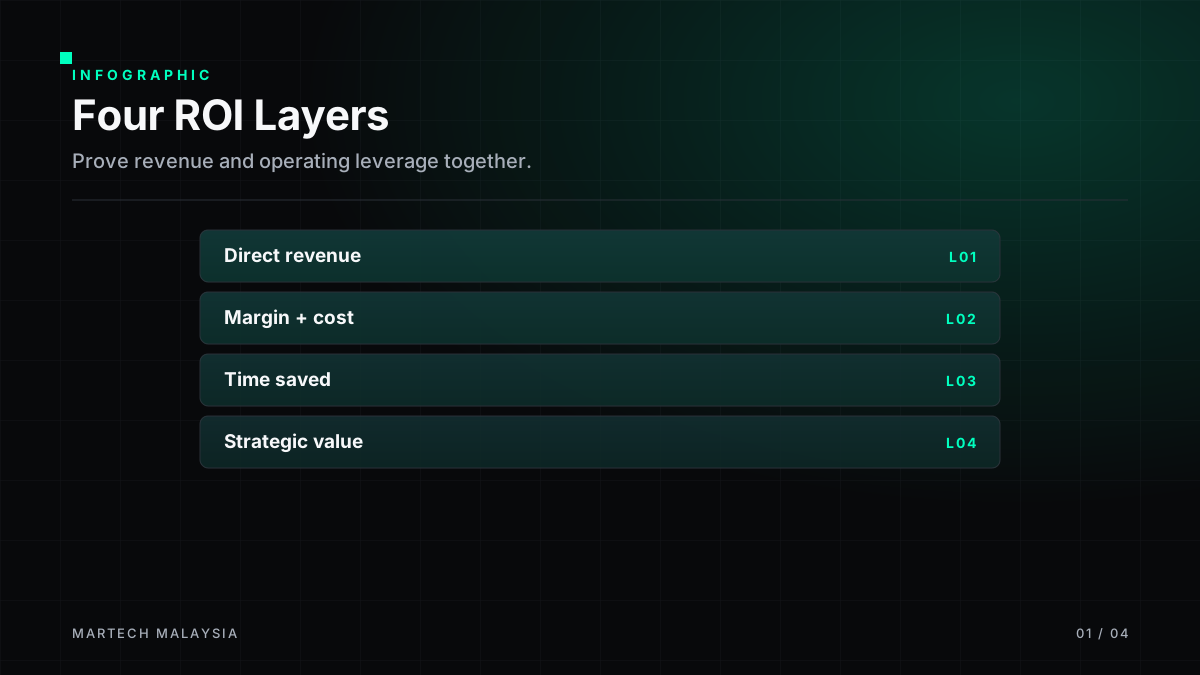
A four-layer ROI framework
Holdouts are the only honest way to measure direct impact
Pick a random 10 to 20 percent of the audience and suppress them from a journey. Compare conversion and revenue between treated and control. The difference is incremental revenue, not co-incident revenue.
- Define the journey and the success metric
- Randomize a holdout group with sufficient size for statistical confidence
- Run for at least one full purchase cycle
- Compare treated vs control on the metric, not platform-attributed revenue
- Roll insights back into program design

Cost components people forget
- Platform license and overage fees
- Content production and design time
- Engineering and integration cost
- WhatsApp per-conversation pricing
- Consent management and compliance tooling
- Internal team time, not just agency invoices
Operational leverage as ROI
If automation frees 20 hours a week of manual list-pulling and one-off sends, that is real value even if no incremental revenue shows up. Quantify hours saved at fully-loaded cost, not just salary.
Benchmarks for Malaysian brands
| Program | Reasonable incremental lift |
|---|---|
| Welcome journey | 8 to 15 percent on new customer 30-day revenue |
| Cart abandonment | 3 to 7 percent of online revenue |
| Browse abandonment | 1 to 3 percent of online revenue |
| Replenishment | 5 to 10 percent on replenishable categories |
| Winback | 1 to 4 percent of revenue, depending on file size |
These are ranges from observed Malaysian and SEA programs. Your numbers will vary. Use them as a sanity check, not a target.

What good reporting looks like
- Incremental revenue from holdouts, by journey
- Net margin contribution after all cost layers
- Time saved, with examples
- Customer experience signals: opt-outs, complaints, NPS
- Quarterly review with the CFO, not just the CMO
Designing journeys for measurable ROI
- Start with the smallest journey that has a clear, suppressible audience
- Build the holdout into the first version, not later
- Hold the treatment constant long enough to learn
- Document what you tried and what you learned, even when it failed
- Reinvest into journeys with proven incremental lift
Common mistakes
- Reporting platform-attributed revenue as ROI without a holdout
- Ignoring cannibalization of organic and paid
- Counting time saved without quantifying it
- Optimizing volume of sends instead of contribution per recipient
- Treating automation as a cost center to defend instead of a value engine to grow
Frequently asked questions
Is platform-attributed revenue ever useful?
Yes as a trend indicator. Just do not present it as ROI to the CFO.
How big should a holdout be?
Large enough for statistical confidence given conversion rate and audience size. For most ecommerce journeys, 10 to 15 percent is sensible.
How often should I refresh ROI numbers?
Headline ROI quarterly. Journey-level holdouts continuously.
What about brand effects?
Automation is rarely a brand channel. If you need brand measurement, pair lift studies with mix modeling.
Where to go next
Defensible ROI is the difference between a marketing automation program that survives budget cuts and one that does not. Build the measurement discipline first, the revenue will follow.
If you want a second opinion on your setup, reach out to cann@martechmalaysia.com or book a diagnostic.
Sources & further reading
- Google. GA4 attribution and conversion modelling.
- Personal Data Protection Department, Malaysia. PDPA 2010 and Amendment Act A1727.
- MarTech Malaysia. Attribution playbook and CDP guide.
Sources retrieved 17 July 2026.