


A customer data platform (CDP) is a marketer-owned system that unifies customer data from every source, stitches identities across devices, applies consent and governance, and pushes governed audiences and events to the tools where you activate them. In Malaysia, it usually sits between your source systems (ecommerce, POS, app, WhatsApp Business, ad platforms) and your activation tools (email, push, ads, CRM, sales) — with your data warehouse as the source of truth or as the CDP itself.
What a CDP actually is (and is not)
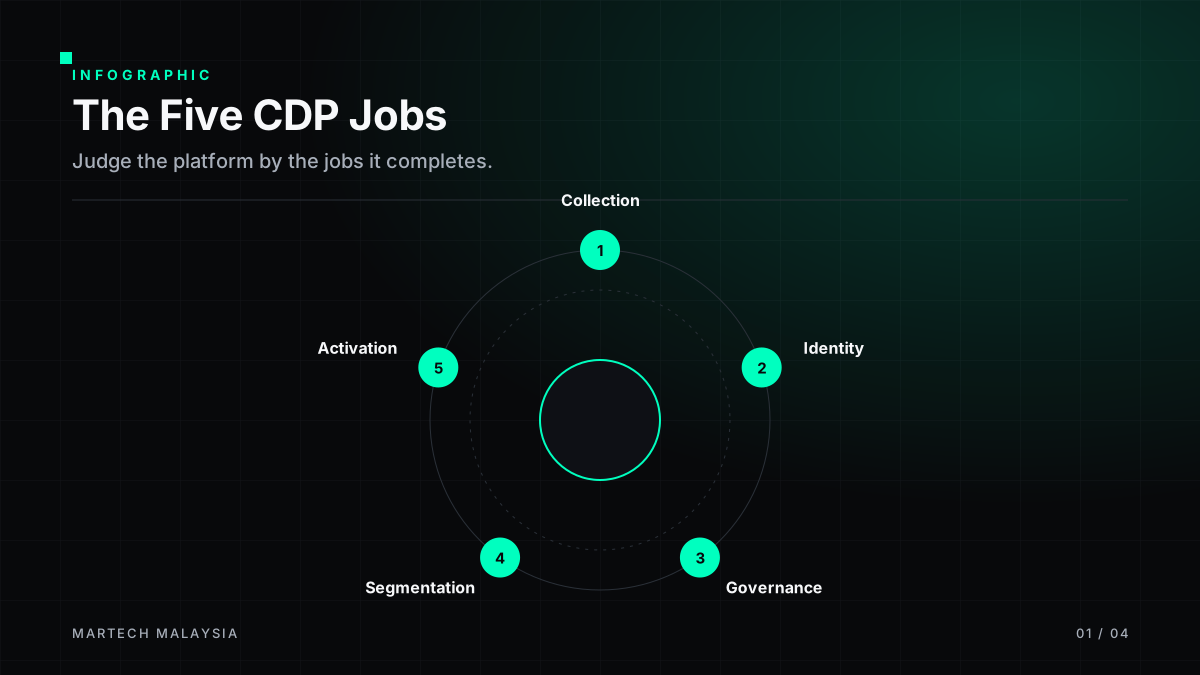
The CDP Institute's original definition is useful: a packaged software that creates a persistent, unified customer database accessible to other systems. In practice you should judge a CDP against five jobs — if a tool cannot do all five, it is a segment of the stack, not a CDP.
1. Collection
SDKs and server-side pipelines that capture events from web, mobile, backend, POS and offline sources into a canonical schema.
2. Identity resolution
Deterministic and probabilistic stitching of anonymous IDs, cookies, device IDs, emails and phone numbers into one customer profile.
3. Governance
Per-purpose consent, data minimisation, retention, audit logs, and enforcement into downstream tools — not just a preference centre.
4. Segmentation
Real-time and batch audiences, event-based triggers, computed traits and predictive scores, all reusable across channels.
5. Activation
Reverse ETL to ad platforms, email/SMS/push, WhatsApp BSPs, CRM, support and personalisation engines — with delivery logs.
What it is not
Not a CRM (system of record for sales), not a DMP (anonymous ad audiences), not a data warehouse (raw storage), and not a marketing automation tool.
For the neighbouring categories and where they overlap, see CDP vs CRM vs DMP for Malaysian marketers.
Reference architecture
Every credible CDP implementation collapses to the same picture: sources on the left, a governed customer core in the middle, activation on the right. The differences are which vendor owns which box.
Sources
Website, mobile app, ecommerce, POS, call centre, WhatsApp Business, offline events, ad platforms, subscription billing.
Collection & taxonomy
Server-side and client-side tracking (RudderStack, Snowplow, Segment, GTM server container). A single event dictionary and identity spec.
Storage
Warehouse (Snowflake, BigQuery, Databricks) or the CDP's proprietary store. Warehouse-native keeps one copy of the truth.
Identity & consent
ID graph, consent ledger, purpose flags, retention windows, cross-border transfer flags for Malaysian and non-Malaysian storage.
Modelling & audiences
SQL/dbt models, computed traits, RFM, propensity, lifecycle stage. Audiences authored once and reused everywhere.
Activation
Reverse ETL and event streams to email, push, WhatsApp BSP, Meta/Google/TikTok, CRM, support, personalisation.
Measurement
Delivery logs, holdouts, incrementality tests, attribution — closed back into the warehouse.
Packaged vs warehouse-native (composable) CDPs
The single biggest architectural decision. Neither is universally right.
| Where data lives | Duplicated inside vendor | Single copy in your warehouse |
| Time to first audience | Fast (weeks) if sources are clean | Slower initial setup, faster ongoing change |
| Data engineering skill required | Lower | Higher (SQL, dbt, warehouse ops) |
| Governance surface | Contained; vendor-defined | You define it in the warehouse |
| Cost driver | MTUs, events, seats | Warehouse compute + activation tool |
| Vendor lock-in | Higher | Lower (data stays in warehouse) |
| Best when | Small data team, urgent activation | Warehouse already exists, complex logic |
Reference documents worth reading before you decide: Segment, RudderStack, Hightouch, Snowplow. For our take on where each fits Malaysian mid-market, see Data Consulting.
Readiness & maturity checklist
Before you shortlist vendors, score yourself honestly. If you score fewer than three yeses, fix collection and taxonomy before you buy anything.
Data ownership
Is there a named person who owns the customer data model and event dictionary? Not a committee.
Event taxonomy
Do you have a documented list of tracked events with properties, or does every team invent its own names?
Identity spec
Do you know how a customer's app, web, email, phone and loyalty IDs get connected — deterministically first?
Consent capture
Are marketing, analytics, personalisation and profiling consents captured separately, timestamped and linkable to a user?
Activation use case
Can you name three campaigns that fail today because the data is scattered? If not, you are solving a hypothetical.
Warehouse
Do you have a working warehouse (Snowflake, BigQuery, Databricks) with at least ecommerce and CRM landed?
Implementation roadmap
Sequence matters more than tool choice. This is the order that survives contact with real Malaysian teams.
Weeks 1–4 · Foundations
Name a data owner. Draft the event taxonomy and identity spec. Inventory sources, consent surfaces and current activation tools. Decide packaged vs composable.
Weeks 5–10 · Collection & identity
Install server-side tracking, unify auth events, land ecommerce and CRM into the warehouse or CDP. Build the initial ID graph. Wire consent capture per purpose.
Weeks 11–16 · First activation
Model two audiences (e.g. abandoned cart, high-value repeat). Sync to email and WhatsApp. Prove one uplift with a proper holdout.
Weeks 17–24 · Scale
Add ad-platform activation, computed traits, propensity/RFM, retention windows, and cross-border transfer controls. Move to routine change requests.
Ongoing · Governance & measurement
Incremental tests, quarterly audits, purpose reviews, DSAR workflow, vendor reviews. Retire duplicate audience logic from downstream tools.
Timeline is a planning illustration for a mid-sized Malaysian retailer/subscription business with one warehouse and 3–5 activation channels. It is not a promise; scope changes it.
Cost structure (planning illustration)
We do not publish universal price tags. What matters is understanding where money goes so you can model your own scenario.
| Software licence | Tiered by MTUs / events / seats | Warehouse (compute + storage) + activation tool (destinations/rows) |
| Implementation | Vendor or partner services, one-off | Internal or partner data engineering, one-off + ongoing |
| Change velocity | Faster small changes; slower schema shifts | Slower small changes; cheaper schema shifts |
| Hidden costs | Add-on modules, over-usage overage | Warehouse cost spikes from unoptimised SQL |
Model both against a real two-year plan. For a budgeting framework, see MarTech budgeting, hiring and tool selection.
Governance & Malaysian privacy
Consent and purpose limitation are not marketing conveniences — they are statutory duties under the Personal Data Protection Act 2010 (Act 709), materially amended by the Personal Data Protection (Amendment) Act 2024 (Act A1727). A credible CDP implementation, whether packaged or composable, must:
- Capture consent per purpose (marketing, analytics, personalisation, profiling) with timestamp, source and version of the notice.
- Propagate consent state to every downstream activation tool and stop sending when consent is withdrawn.
- Support data-subject rights: access, correction, withdrawal and, where applicable, portability.
- Record cross-border transfers and the basis relied upon, in line with the Commissioner's cross-border transfer guideline.
- Log processor access and maintain vendor agreements consistent with the amended Act.
For the marketer-oriented playbook, see PDPA Malaysia compliance for marketers. Always consult the current Commissioner documents at pdp.gov.my for exact thresholds, notification periods and DPO criteria — do not rely on summaries.
Common failure modes
Buying before you can track
Signing a CDP contract while your GA4/GTM setup is broken. You end up modelling the same bad data faster.
No named owner
"The CDP" is treated as a project. It needs a permanent product owner with the authority to say no.
Consent theatre
A cookie banner that captures consent but does not propagate to downstream tools. Legally and operationally hollow.
Duplicate audiences
Every channel builds its own audience logic. The CDP becomes another silo instead of the source of truth.
Vanity KPIs
Counting profiles instead of measuring incremental revenue. Move to holdouts within the first quarter of activation.
Big-bang launch
Trying to migrate everything before proving one use case. Two audiences shipped > twenty audiences designed.
Build vs buy vs compose
The honest choices are these:
Buy packaged
You need speed, you have no data engineering team, and your data lives in SaaS sources. Accept the licence cost and the lock-in in exchange for time.
Compose on warehouse
You already run a warehouse, you have SQL/dbt capability, and your logic is complex or highly regulated. You keep one copy of the truth.
Build from scratch
Rarely the right answer in 2026. Reserve it for organisations with unique regulatory or scale constraints and a genuine platform team.
Frequently asked questions
Is a CDP a replacement for our CRM?
No. Your CRM is the system of record for sales relationships and pipeline. The CDP unifies behavioural and identity data and pushes governed audiences into the CRM (and other tools). They are complementary. See CDP vs CRM vs DMP.
Do we need a data warehouse before a CDP?
Strongly recommended. Without a warehouse you either duplicate data inside the CDP or lose the ability to reason about it end-to-end. If you already have Snowflake, BigQuery or Databricks, composable is usually the cheaper long-term choice.
How long does a real CDP implementation take?
First activation in 8–12 weeks is realistic when foundations exist. A full programme with governance, measurement and multi-channel activation typically runs 6–9 months. Anyone quoting a two-week "deployment" is selling a preference centre.
Does a CDP make us PDPA-compliant automatically?
No. The CDP is where you enforce the controls you already need. Compliance depends on your notice, your consent capture, your retention, your vendor contracts and your cross-border basis — not on the logo on the invoice.
We are a small business. Do we need a CDP?
Usually not yet. If you have fewer than three activation channels and clean data in Shopify/HubSpot, native integrations plus one BI layer will take you further than a CDP for another 12–18 months.
What is the safest first project?
Unify web + ecommerce + CRM, build one high-value audience (e.g. repeat purchasers within 90 days), sync to email and WhatsApp with a proper holdout, and publish the incremental result. Everything else follows.
Where to go next
Pair this with first-party data strategy for a cookieless Malaysia, customer segmentation for Malaysian ecommerce, and the PDPA marketer playbook. When you are ready for a paid diagnostic, get in touch.
Sources & further reading
All sources retrieved 17 July 2026.
- Personal Data Protection Act 2010 (Act 709) — official page
- Personal Data Protection (Amendment) Act 2024 (Act A1727)
- Guidelines on Cross-Border Transfer of Personal Data (CBPDT)
- Segment documentation
- RudderStack documentation
- Hightouch documentation
- Snowplow documentation
- CDP Institute — definition and category resources