


Pillar page
Server-side Google Tag Manager in Malaysia: an implementation guide
Server-side GTM moves tag execution from the browser to a server you control. It improves performance, increases data quality, and gives Malaysian teams a defensible stance under PDPA. This guide walks through what it is, when it is worth it, and how to roll it out without burning the analytics setup down.
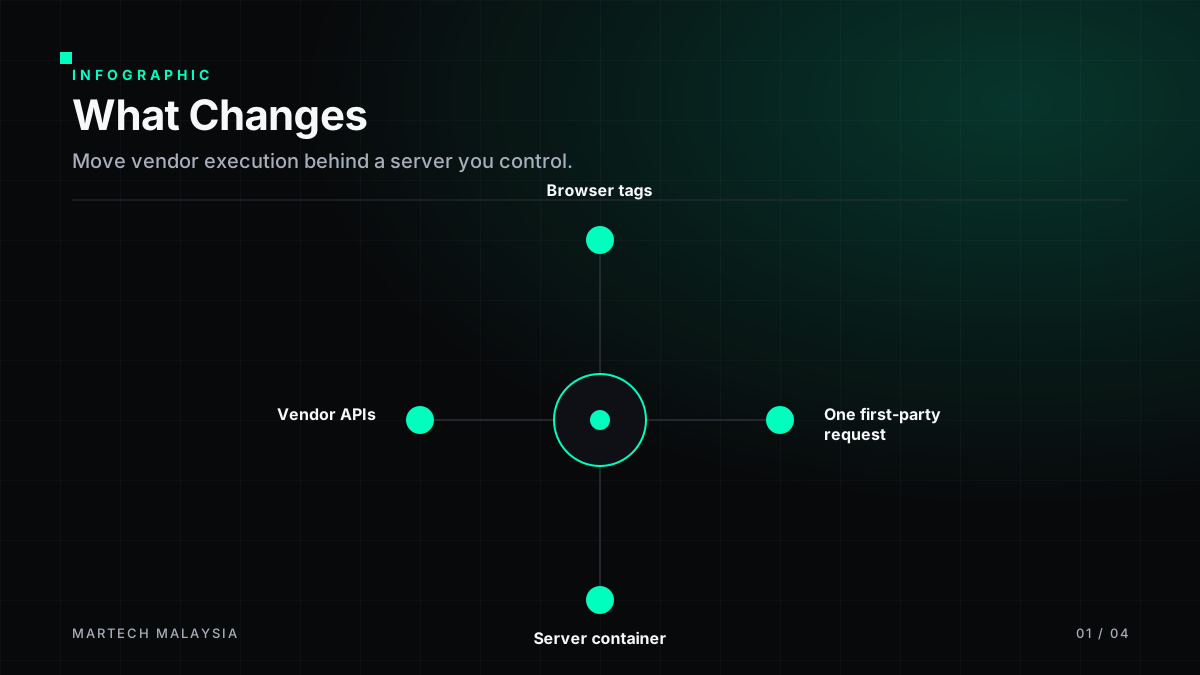
What changes when you move server-side
The user-facing payload becomes one request you control. Vendor calls happen server-to-server, with cleaner data, better reliability, and stronger privacy controls.

Why Malaysian teams are adopting it
- Improved Conversions API reliability with Meta, Google, and TikTok
- Better page performance, which helps Core Web Vitals and SEO
- Cleaner first-party cookies, less data lost to ITP and ad blockers
- Stronger PDPA posture: you decide what data leaves your domain
- Centralized control over which vendors receive which events
Architecture in plain English
A server-side container runs on your subdomain, for example sgtm.yourbrand.com. The browser sends a single GTM client request to that subdomain. The server container then transforms and forwards the event to GA4, Meta, Google Ads, TikTok, your CDP, or anywhere else you configure.
- Browser fires gtag or dataLayer event
- Client-side GTM sends one request to your server container
- Server container parses the event
- Server container fires vendor tags using their server APIs
- First-party cookies live on your domain, not third-party domains

Hosting options
| Option | Pros | Cons |
|---|---|---|
| Google Cloud App Engine | Officially supported, easy setup | Higher monthly cost, GCP lock-in |
| Stape | Managed sGTM, simple billing | Adds a third-party operator to your stack |
| Self-hosted on Cloud Run | Full control, can be cheaper | Operational overhead |
For most Malaysian SMEs, a managed provider gives the best speed-to-value. Larger brands with engineering capacity often prefer Cloud Run.

What to migrate first
- GA4 events. Lowest risk, immediate benefit in data quality.
- Meta Conversions API. High impact on ad performance.
- Google Ads conversions. Cleaner Enhanced Conversions handoff.
- TikTok and LinkedIn events.
- CDP and custom destinations.
PDPA implications
Server-side GTM does not remove the need for consent, but it does let you enforce consent before any data reaches a vendor. Combine it with Google Consent Mode and a documented consent management policy.
- Read consent on the server before firing destination tags
- Strip or hash personally identifiable fields based on consent state
- Log every outbound vendor call for auditability
- Document data flows for your DPO
Performance and reliability
Page weight typically drops because only one client tag is needed. Conversion match rates with Meta and Google often improve by 10 to 30 percent thanks to server events. Tracking survives ITP-driven cookie expiry on Safari and Firefox.
Common implementation pitfalls
- Forgetting to set up first-party cookies on your subdomain
- Not validating consent on the server before forwarding events
- Sending raw email or phone instead of hashed values to ad platforms
- Ignoring server logs and only debugging from the browser
- Underestimating monthly hosting cost on busy storefronts

A practical rollout plan
- Week 1: provision the server container, set up subdomain, configure GA4
- Week 2: parallel-run GA4 client and server, compare daily
- Week 3: migrate Meta and Google Ads conversions
- Week 4: cut over consent handling to the server
- Week 5-6: add CDP and custom destinations, document the architecture
Frequently asked questions
Will I still need client-side GTM?
Yes for some interactions like form events. The client container becomes much lighter.
How much does it cost to run?
From around USD 120 per month for managed plans on small sites, scaling with request volume.
Will server-side GTM bypass ad blockers entirely?
No. It improves data quality significantly but determined blockers can still catch the initial request. Subdomain delivery helps.
Is this only for Google stack?
No. Many vendors including Meta, TikTok, LinkedIn, Iterable, and Segment publish server-side templates.
Where to go next
Server-side GTM is one of the highest-leverage upgrades a Malaysian digital team can make in 2026. It improves performance, defends ad attribution, and aligns the tracking layer with PDPA expectations at the same time.
If you want a second opinion on your setup, reach out to cann@martechmalaysia.com or book a diagnostic.
Sources & further reading
- Google. Server-side Tag Manager official documentation.
- Google Cloud. Cloud Run — hosting reference for sGTM.
- Meta. Conversions API developer docs.
- Personal Data Protection Department, Malaysia. PDPA and cross-border transfer guideline.
- MarTech Malaysia. First-party data strategy.
Sources retrieved 17 July 2026.