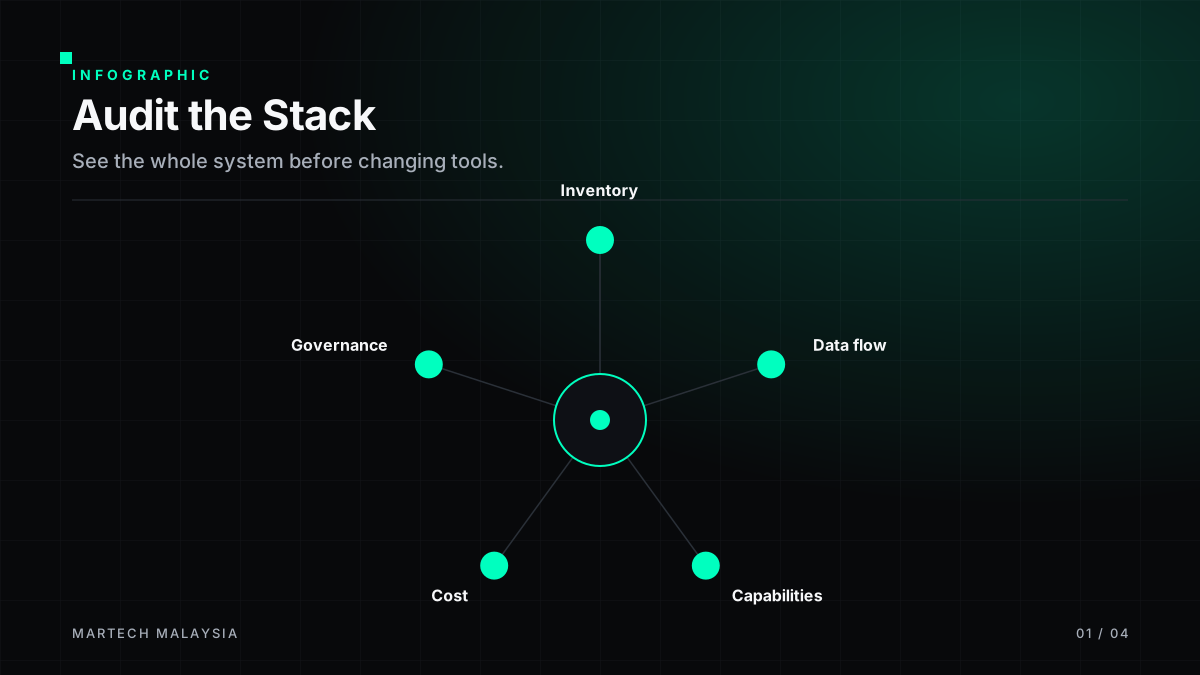


Most marketing teams don't have a tooling problem — they have a tooling visibility problem. Licences renewed on autopilot, duplicate point solutions bought by different squads, tracking scripts nobody owns, and integrations held together by a single Zapier account belonging to someone who left last year. A MarTech stack audit is how you get that back under control before the next budget cycle.
This checklist is written for marketing leaders, RevOps and MarTech consultants working with Malaysian SMEs and mid-market enterprises. It walks through the six audit workstreams we run on paid discovery engagements: inventory, data-flow mapping, capability & gap analysis, cost & contract review, governance & PDPA, and a prioritised remediation roadmap. You can run it yourself over two to four weeks, or use it as the scope brief when you hire an external consultant.
Why audit your MarTech stack now
Gartner's annual Marketing Technology Survey has reported for several years that marketers use less than a third of the capabilities in the tools they already pay for. That gap is where audit ROI comes from — not from ripping tools out, but from turning shelfware into shipped workflows and killing spend that no longer maps to a business outcome.
Trigger events that should force an audit:
- Annual budget planning or a CFO-led cost review.
- A CRM, CDP or marketing-automation migration on the roadmap.
- A merger, rebrand, or new market entry (e.g. expanding from Malaysia into Singapore or Indonesia).
- A new Head of Marketing, CMO or RevOps lead inheriting an unfamiliar stack.
- PDPA, GDPR or sector-specific compliance review (BNM RMiT, Bank Negara guidelines for financial services, MOH data guidelines for healthcare).
- Consistent attribution disputes between marketing, sales and finance.
Define the audit scope before you start
Scope creep is the single biggest reason audits stall. Before opening a single admin console, agree on the following in writing with your sponsor:
- Business questions the audit must answer. Examples: "Can we cut 20% of MarTech spend without hurting pipeline?", "Are we PDPA-defensible on consent?", "Do we need a CDP, or can HubSpot / Salesforce do the job?"
- Systems in and out of scope. Marketing-owned tools are always in. Sales tools (CRM, sales engagement), service tools (helpdesk, CSAT) and data platforms (warehouse, BI) are usually in if they exchange customer data with marketing.
- Regions and brands. A multi-brand group in Malaysia often has parallel stacks per brand — decide whether the audit is per-brand or consolidated.
- Deliverables. At minimum: a stack inventory, a data-flow diagram, a gap-analysis matrix, a cost summary, and a 30/60/90-day plan.
- Timeline and access. Two to four weeks is realistic. You need admin (not user) access to every tool, plus finance access to contracts and invoices.
Step 1 — Build a complete stack inventory
The inventory is the spine of the audit. Everything else references it. Use a spreadsheet or Notion/Airtable database with one row per tool and the following columns:
- Tool name and vendor
- Category (CRM, CDP, ESP, analytics, ad platform, CMS, tag manager, chat, survey, etc.)
- Primary business owner (a named person, not a team)
- Technical/admin owner
- Number of seats / MAUs / contacts
- Annual cost (MYR, normalised from USD/SGD at a fixed FX rate)
- Contract end date and notice period
- Renewal type (auto-renew, opt-in, month-to-month)
- Data classification (does it store PII, payment data, health data?)
- Integrations in / out (list the systems it sends and receives data from)
- Business capability supported (e.g. "lead capture", "lifecycle email", "attribution")
- Utilisation score (0–3: unused, light, core, critical)
- Confidence in the row (High / Medium / Low)
Where to find every tool (including the ones nobody told you about)
Marketers underestimate their stack by 30–50% on the first pass. To catch shadow tools:
- Finance export. Pull 24 months of AP/credit-card statements and filter for anything SaaS-shaped. Two years catches annual renewals.
- SSO / IdP export. Google Workspace, Microsoft Entra, Okta and JumpCloud can list every app anyone has ever signed into.
- Tag Manager audit. Open GTM (or equivalent) and list every tag, trigger and variable. Each tag is usually a tool.
- DNS & CNAME records. Sending domains, tracking subdomains and email authentication records reveal ESPs, CDPs and analytics tools.
- Browser scan. Run a tool like BuiltWith, Wappalyzer or a Lighthouse network trace on your key pages.
- Stakeholder interviews. Ask each squad lead: "What do you log into weekly?" and "What broke in the last 90 days?"
Reconcile these five lists into the single inventory. Anything that appears in one source but not another gets flagged as low-confidence and re-verified.
Step 2 — Map the customer data flow
A stack inventory tells you what you have. A data-flow map tells you whether it works. This is where most audits find the highest-ROI fixes.
For every tool in the inventory, document:
- Sources — where does data enter this system? (forms, CSV, API, reverse ETL, iPaaS)
- Destinations — where does it go next? (CRM, ESP, warehouse, ad platforms)
- Sync mechanism — native integration, Zapier/Make, custom middleware, manual export
- Sync frequency — real-time, hourly, daily, on-demand
- Identity key — email, phone (E.164), user_id, cookie, device ID
- Failure mode — what happens when it breaks, and who gets alerted
Draw this as a directed graph. A whiteboard, Miro, Lucidchart or a simple Mermaid diagram all work. The output should let a new team member answer, in under five minutes, "How does a lead from a Meta ad end up in a WhatsApp welcome flow?"
Identity resolution: the audit's toughest question
Most Malaysian stacks accumulate three or more identity keys — CRM contact ID, email, phone, GA client_id, ad-platform hashed email. During the audit, pick one canonical identity key (usually a CDP profile ID or CRM contact ID) and score every integration on whether it round-trips that key correctly. Integrations that lose identity between hops are the top candidate for either middleware or a customer data platform. Our CDP practical guide and CDP vs CRM vs DMP pieces walk through when a CDP is genuinely warranted vs when better CRM hygiene will do.
Step 3 — Capability & gap analysis
Now match tools to capabilities, not the other way around. Build a matrix with capabilities as rows and tools as columns. Suggested capability list for a B2C or B2B2C stack:
- Acquisition — paid media buying, SEO, content, referral
- Web & conversion — CMS, landing pages, A/B testing, personalisation
- Data collection — analytics, tag management, server-side tracking, product analytics
- Identity & profile — CRM, CDP, identity resolution
- Engagement — email, SMS, push, WhatsApp, in-app
- Orchestration — journey builder, marketing automation, lead scoring
- Advertising activation — audience sync, offline conversions, CAPI
- Measurement — attribution, incrementality, MMM, dashboards
- Governance — consent management, DSAR workflow, data retention
For every cell, mark: covered, partially covered, overlapping, or gap. Overlaps are cost-reduction candidates. Gaps are either capability-purchase candidates or, more often, "we already own a tool that does this but nobody turned it on" (shelfware).
Finding shelfware: the 20-minute test
Cross-reference the capability matrix with the utilisation score from your inventory. Any tool with utilisation ≤ 1 and a duplicate in the matrix is a candidate for consolidation. Any tool with utilisation ≤ 1 and no duplicate is a candidate for either activation (turn on the feature) or cancellation at next renewal. In our engagements, this single exercise typically identifies 15–30% of annual MarTech spend as recoverable.
Step 4 — Cost & contract review
Once the capability matrix is in place, layer cost on top. For each tool capture:
- Annual list price
- Effective annual price after discounts
- Price per active user / contact / MAU
- Overage risk (contact-tier ESPs, event-based product analytics, ad-spend-based tools)
- Auto-renewal date and notice-period deadline
- Termination clauses and data-export rights
Rank tools by cost per business outcome, not cost per seat. A MYR 60k/year attribution tool that changes zero decisions is more expensive than a MYR 200k/year CDP that reduced acquisition cost by 15%.
Step 5 — Governance, consent and PDPA review
Malaysia's Personal Data Protection Department (JPDP) enforces the PDPA 2010 and its 2024 amendments, including mandatory Data Protection Officer appointment for certain classes of data users and a data-breach notification regime. Your audit must produce clean answers to:
- Which tools store personal data of Malaysian data subjects?
- Where physically is that data stored (Malaysia, Singapore, EU, US)?
- Do we have a lawful basis / valid consent for each processing purpose?
- Is our consent-capture UI compliant (granular, opt-in, easy-to-withdraw)?
- Can we honour a Data Subject Access Request (DSAR) or erasure request within statutory timelines across every tool?
- Do we have a documented data-retention policy per tool?
- Have we appointed a DPO where required?
Our PDPA compliance guide for marketers walks through the operational controls in depth. For sector-specific overlays, cross-check Bank Negara Malaysia RMiT guidelines (financial services) and MCMC guidelines (telco).
The MarTech stack audit scorecard
Roll every workstream into a single 100-point scorecard so the executive readout is a number, not a novel. Suggested weighting:
- Inventory completeness (15 pts) — every tool mapped, owned and classified.
- Data-flow integrity (20 pts) — canonical identity, no broken syncs, alerting in place.
- Capability coverage (15 pts) — no critical gaps, no unjustified overlaps.
- Utilisation (15 pts) — <10% shelfware by spend.
- Cost efficiency (10 pts) — benchmarked cost per outcome.
- Governance & PDPA (15 pts) — consent, DSAR, retention, DPO.
- Team & process (10 pts) — owners named, runbooks documented, on-call defined.
Under 60 is a burning platform. 60–75 is typical for a growing SME. 75–90 is mature. Above 90 usually means the audit was too generous — re-check inventory completeness.
Step 6 — Build a 30 / 60 / 90-day remediation roadmap
The point of the audit is action. Group findings into three horizons:
- 0–30 days — stop the bleeding. Cancel confirmed shelfware before the next renewal. Fix any consent or PDPA gap that creates regulatory risk. Assign named owners to every tool that doesn't have one.
- 30–60 days — consolidate. Retire overlapping tools, migrate their workflows to the survivor. Fix the highest-value broken data flow. Publish the canonical identity policy.
- 60–90 days — build. Fill the one or two capability gaps that block a specific business goal (usually attribution, lifecycle orchestration, or server-side tracking). Stand up a MarTech governance forum that meets monthly.
Each item on the roadmap needs an owner, a due date, a success metric and an estimated cost or saving. Anything without those four fields is a wish, not a plan.
Who should run the audit
Small teams (under ~5 marketers) can self-audit using this checklist over three to four weekends. Mid-market teams usually benefit from an external consultant for the first audit — you get a benchmarked view, faster stakeholder access, and a written report the CFO will actually read. If you're weighing that decision, our guide on freelance vs agency vs in-house compares total cost, and how to choose a MarTech consultant in Malaysia covers the scorecard and interview questions.
What "done" looks like
By the end of a well-run audit you should be able to hand your CMO or CEO a single folder containing:
- The stack inventory spreadsheet
- The data-flow diagram (with canonical identity annotated)
- The capability / gap matrix
- The cost & contract summary with renewal calendar
- The PDPA / governance findings memo
- The scorecard
- The 30/60/90-day roadmap with owners and metrics
If any one of those is missing, the audit isn't finished.
Frequently asked questions
How long does a MarTech stack audit take?
Two to four weeks of elapsed time for a mid-market stack (15–40 tools), assuming admin access is unblocked in week one. Self-audits by internal teams typically take longer because audit work competes with BAU.
How much should we budget for an external audit?
Independent Malaysian consultants typically scope a paid-discovery audit at MYR 25k–80k depending on stack size and number of stakeholders. Boutique agencies quote MYR 60k–150k. See the MarTech budgeting guide for how audit spend fits inside a full-year plan.
What's the fastest ROI from an audit?
Cancelling shelfware before auto-renewal. In most engagements we cover the audit fee two to three times over from year-one savings on the first renewal cycle alone.
Do we need a CDP after the audit?
Sometimes. If your data-flow map shows identity is fragmented across four or more systems and your CRM/ESP can't resolve it, a CDP is often the right answer. If identity is fine but activation is slow, the answer is usually orchestration, not another data platform. Read our CDP primer before committing.
How often should we re-audit?
Full audit once a year, aligned to budget. A lightweight quarterly review of inventory, utilisation and renewals keeps the stack from drifting between audits.
Next step
If you want a second pair of eyes on your stack, our discovery call is free, non-obligatory and specifically scoped to walk through this checklist against your current tools. You leave with the scorecard and the top three remediation priorities regardless of whether we work together.
Sources & further reading
- Personal Data Protection Department Malaysia (JPDP) — PDPA guidance and enforcement notices.
- Bank Negara Malaysia — RMiT and related data-governance guidelines for financial services.
- Gartner Marketing Technology — annual MarTech survey and stack-utilisation benchmarks.
- chiefmartec.com — Scott Brinker's annual MarTech landscape, useful for category mapping.