
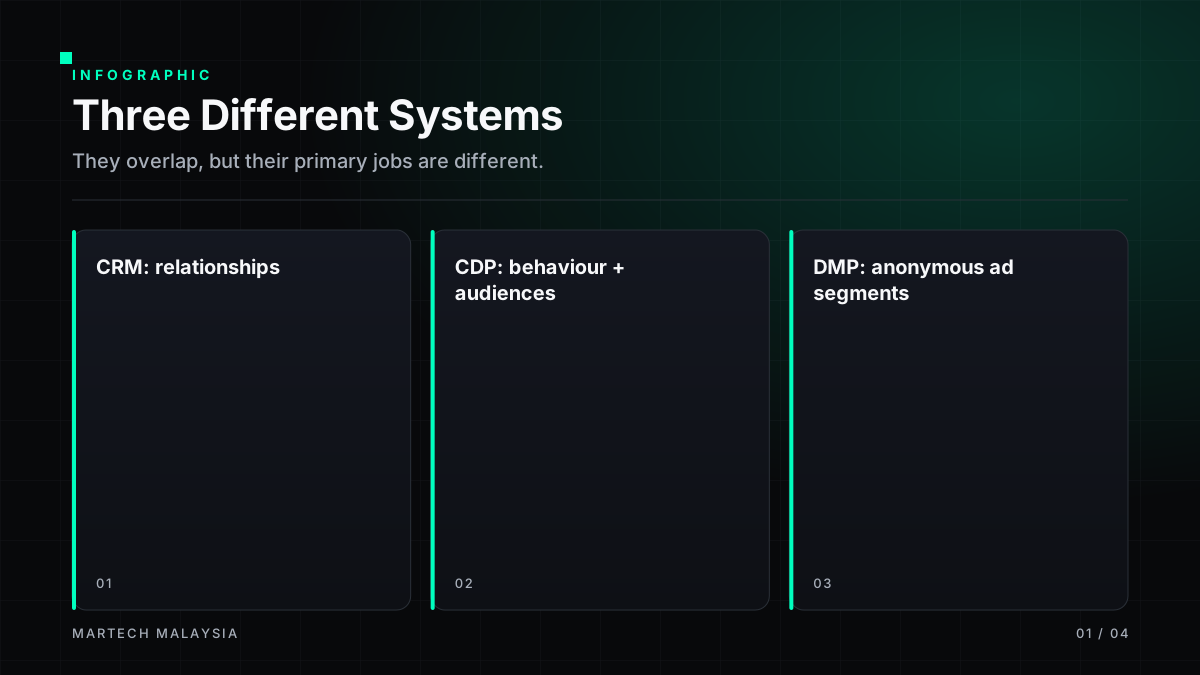


CRM, CDP and DMP are not competing brands — they are different jobs in the customer stack. A CRM is your system of record for known people and pipeline. A CDP is your identity and activation layer for known and anonymous behaviour, governed by consent. A DMP is a fading advertising audience store for anonymous browser and device signals. Most Malaysian teams need a CRM and a CDP; almost none still need a DMP in 2026.
Clear definitions
CRM — Customer Relationship Management
Structured records for identified customers and prospects: accounts, contacts, opportunities, tickets, calls, notes. Optimised for pipeline management and service history. Examples: Salesforce Sales Cloud, HubSpot CRM, Zoho CRM.
CDP — Customer Data Platform
Marketer-owned platform that unifies data from every source, resolves identity, enforces consent, builds audiences, and activates them to downstream tools. Examples: Segment, Tealium, Bloomreach, and warehouse-native compositions (Snowflake + Hightouch).
DMP — Data Management Platform
Historically an advertising-side store for anonymous cookies and device IDs, used to build lookalikes and third-party segments. Examples: Adobe Audience Manager (sunsetting), legacy Oracle BlueKai.
Side-by-side comparison
| Primary user | Sales, service | Marketing, data | Media buying |
| Identity type | Known (PII) | Known + anonymous, stitched | Anonymous (cookie/device) |
| Data granularity | Records & interactions | Events + traits + audiences | Segments (aggregate) |
| Retention window | Long (years) | Configurable per purpose | Short (weeks–months) |
| Consent handling | Contact-level flags | Per-purpose ledger | Cookie-based, often opaque |
| Activation surface | Sales/service tools | Email, push, ads, personalisation, CRM | DSPs, ad networks |
| Source of truth for | Pipeline & service history | Customer behaviour & audiences | Anonymous ad segments |
| Relevance in 2026 | High | High | Declining |
How data flows between them
Sources
Website, app, POS, ecommerce, WhatsApp Business, ad platforms, offline events.
CDP (identity + consent + audiences)
Collects events, stitches IDs, enforces consent, models audiences and traits.
CRM
Receives enriched profiles, lifecycle stage, propensity scores. Sends back pipeline outcomes and support signals.
Ad platforms / clean rooms
Receive hashed first-party audiences from the CDP. DMPs, where still used, sit here rather than at the centre.
Warehouse
Underneath it all — the single copy of truth for measurement and modelling.
Where they overlap (honestly)
Vendors blur categories deliberately. The overlap is real and it is worth naming so you do not overbuy.
CRM with marketing hub
HubSpot and Salesforce Marketing Cloud include audience-building, email, and lightweight identity features. For smaller Malaysian SMEs with a single channel, this can cover 70% of what a CDP would do. See the automation shortlist for Malaysian SMEs.
CDP with CRM-like fields
Most CDPs store contact traits and can push them into a CRM. They are not a replacement for sales pipeline management.
Ad platform "audiences" ≠ DMP
Meta, Google and TikTok now hold their own audience management within walled gardens, often replacing what a DMP used to do.
Warehouse + reverse ETL
A composable CDP is functionally a CDP even without a "CDP" logo. Judge on jobs done, not category label.
Decision tree
Do you have a sales team managing named accounts?
Yes → you need a CRM. No → you may still need a lightweight contact database, but not a full CRM.
Do you activate to more than two channels with logic that depends on behaviour?
Yes → you need a CDP (packaged or composable). No → native integrations from your CRM/marketing tool are enough.
Do you already run a data warehouse with SQL/dbt capability?
Yes → warehouse-native / composable CDP is usually cheaper and cleaner. No → packaged CDP will move faster, at higher licence cost.
Do you still buy anonymous third-party audiences at scale?
Yes → you may still touch a DMP or clean room. No → skip it; invest in first-party audiences instead.
Is your PDPA consent captured per purpose and propagated to downstream tools?
No → fix this before any of the above. See the PDPA marketer playbook.
Real-world use cases in Malaysia
Ecommerce (Shopify, Magento)
CRM: HubSpot for wholesale/B2B side. CDP: warehouse-native or Segment. DMP: not needed — activate first-party audiences directly to Meta/TikTok/Google.
Retail with POS
CRM: loyalty CRM (Zoho/Salesforce). CDP: unify POS + ecommerce + app; drive WhatsApp and email lifecycle. DMP: no.
B2B SaaS
CRM: HubSpot/Salesforce is the centre. CDP: light — product analytics + reverse ETL to CRM. DMP: no.
Media / publisher
CDP for logged-in audiences; clean rooms for advertiser collaboration. DMP: only if you still monetise anonymous inventory.
Common mistakes
Buying a CDP as a CRM
You will fail to manage pipeline. Sales won't adopt it.
Buying a CRM as a CDP
You will run out of activation flexibility once you exceed two channels.
Still buying a DMP in 2026
Third-party cookie deprecation, mobile ATT and PDPA together have reduced DMP utility dramatically. Prefer first-party plus clean rooms.
Skipping identity design
Buying either tool without an ID spec creates duplicate profiles and unusable audiences.
Frequently asked questions
Do we need both a CRM and a CDP?
Most mid-sized Malaysian businesses that sell to identifiable customers eventually do. The CRM manages pipeline and service; the CDP manages behaviour and activation. They exchange data both ways.
Isn't HubSpot / Salesforce Marketing Cloud already a CDP?
They contain CDP-like features (audiences, identity, segmentation) but are optimised for their own activation surface. They struggle with real-time cross-channel activation and warehouse-native governance. Fine as a first step, not always a final destination.
Is the DMP dead?
Not entirely — some publishers and ad-tech vendors still run one. But for most Malaysian marketers, its jobs have moved to first-party CDPs and clean rooms (Google Ads Data Hub, Meta Advanced Analytics, LiveRamp).
If we can only fund one this year, which comes first?
If you have no sales pipeline management: CRM. If you have a CRM and are stuck activating across channels: CDP. If you have both and want more reach: invest in first-party data and clean rooms before considering a DMP.
Does PDPA change the answer?
Yes. A CDP with a proper consent ledger is easier to keep compliant than a DMP that relies on third-party cookies. See PDPA compliance for marketers.
Related reading
Practical guide to CDPs · First-party data strategy · Segmentation for Malaysian ecommerce · Data consulting Malaysia · Talk to us.
Sources & further reading
All sources retrieved 17 July 2026.