
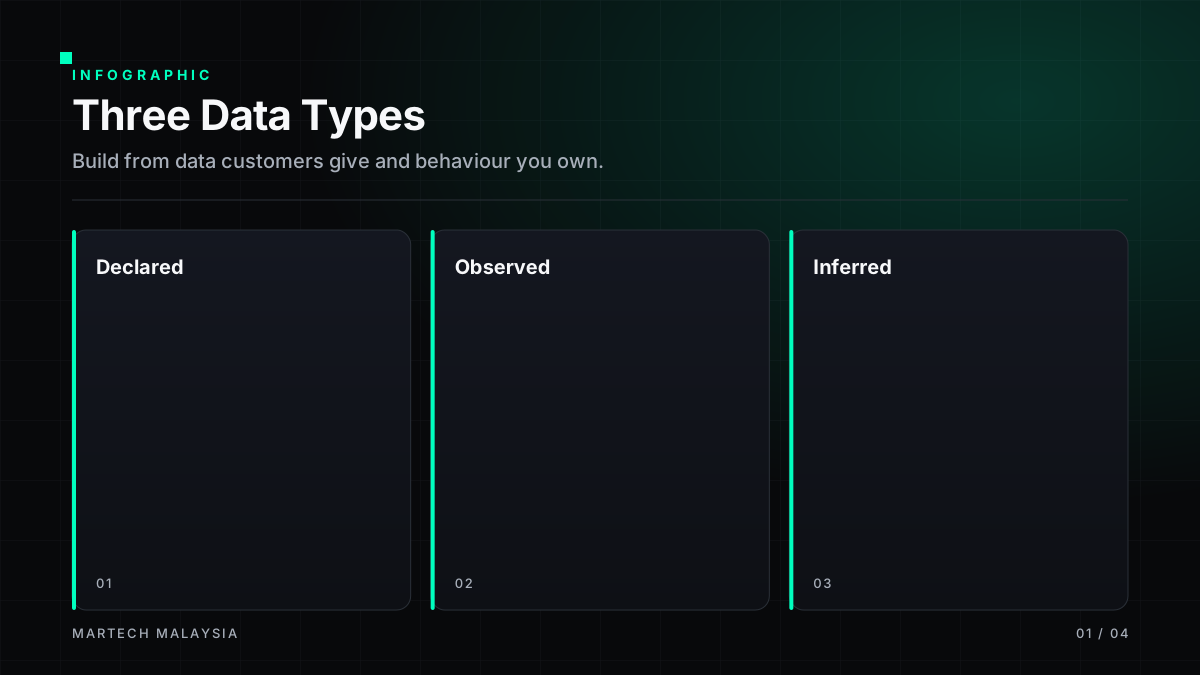


A first-party data strategy is how your business collects, unifies, governs and activates data you obtain directly from your own customers, with their consent, on your own surfaces — website, app, checkout, POS, WhatsApp, email, support. In a Malaysian market where third-party cookies, mobile identifiers and cross-site tracking are all narrowing, first-party is no longer a nice-to-have: it is the only durable source of measurable audience data.
Why this matters in Malaysia now
- Apple's App Tracking Transparency and Safari's ITP have already shrunk third-party attribution.
- Chrome's Privacy Sandbox continues to reshape addressability. Third-party cookies are unreliable, not a strategy.
- The Personal Data Protection (Amendment) Act 2024 raised the operational bar for consent, breach handling and processor accountability.
- Malaysian consumers are increasingly comfortable transacting on WhatsApp — an inherently first-party surface.
See also our PDPA marketer playbook and data consulting.
What counts as first-party data
Declared
Data the customer gives you directly: name, email, phone, preferences, survey answers, loyalty sign-ups, quiz responses.
Observed
Behaviour on your surfaces: page views, product views, cart events, checkout events, app opens, message reads.
Inferred
Derived attributes: RFM, propensity to churn, lifecycle stage, predicted LTV. Built from declared + observed data.
Zero-party (subset of declared)
Preferences and intents explicitly shared for a specific benefit, e.g. "notify me when back in stock in size M".
Collection-to-activation architecture
1 · Value exchange & capture
Clear reason to share data — better service, faster checkout, relevant content. Notice and consent are captured per purpose, in plain Bahasa Malaysia/English.
2 · Event taxonomy
A documented dictionary of events (e.g. product_viewed, cart_updated, checkout_completed) and identifiers (user_id, anonymous_id, email_hash, phone_hash).
3 · Collection layer
Server-side tracking wherever possible (RudderStack, Snowplow, Segment, GTM server container). Reduces reliance on browser and ad-blocker fragility.
4 · Identity & consent
Deterministic stitching first (login events, purchases). Consent state stored with timestamp and version, propagated to every downstream tool.
5 · Warehouse / CDP
One source of truth. Modelled traits and audiences maintained here, not duplicated per tool.
6 · Activation
Reverse ETL to email, WhatsApp BSP, push, ads (hashed first-party matches), CRM, support, personalisation.
7 · Measurement
Holdouts, incrementality tests, MMM inputs. Results closed back into the warehouse.
Value exchange design
Customers share data when they get something back. If the only reason on the page is "for marketing purposes", you will be scraping the barrel.
Convenience
Faster checkout, address autofill, order history, saved size/preferences.
Access
Early access to drops, exclusive content, member-only sizes and colours.
Recognition
Loyalty tiers, milestone rewards, birthday benefits.
Utility
Restock alerts, price-drop alerts, appointment reminders.
Event taxonomy essentials
Without a taxonomy, every team invents its own event names and the CDP becomes a landfill. Adopt a small, documented dictionary and enforce it in code review.
| identify | User logs in or is recognised | user_id, email_hash, phone_hash, consent_state |
| product_viewed | PDP loaded | product_id, category, price, currency (MYR) |
| cart_updated | Item added/removed | cart_id, items[], value, currency |
| checkout_started | Checkout initiated | cart_id, value, payment_method_hint |
| order_completed | Payment succeeds | order_id, value, tax, shipping, items[] |
| message_sent | Outbound WhatsApp/email delivered | channel, template_id, campaign_id, consent_purpose |
Identity resolution
Deterministic first
Login, order_completed and checkout events attach a stable user_id to previously anonymous behaviour. This is your ID graph's backbone.
Hashed PII for matching
SHA-256 hashed email and phone for ad-platform matching. Never share plaintext PII with ad networks.
Cross-device
Login on web + app + POS is the cleanest bridge. Avoid probabilistic stitching unless the accuracy is measured and disclosed.
Consent-aware
Identity resolution happens only for purposes the customer consented to. Withdrawal must cascade.
Consent & governance
- Notice in plain language, at the point of collection, in the language of the form.
- Separate consents per purpose: marketing, analytics, personalisation, profiling, third-party sharing.
- Withdrawal must be as easy as consent. Log both events with timestamp.
- Retention defined per purpose and enforced automatically, not by memory.
- Vendor list maintained. Cross-border transfers documented per Commissioner guideline.
See PDPA Malaysia compliance for marketers and PDPA-compliant form design.
Activation patterns that work
Hashed first-party audiences
Push hashed emails/phones to Meta, Google, TikTok as Custom Audiences. Preserve match rates without exposing PII.
Suppression, not just targeting
Suppress recent purchasers, unsubscribers, and consent-withdrawn users. Often the biggest immediate CPA win.
Lifecycle messaging
WhatsApp + email flows keyed to observed behaviour: welcome, browse-to-cart, cart-to-checkout, post-purchase, winback.
Onsite personalisation
Return customers see recognisably different homepages, recommendations and inventory relevance.
Clean rooms
Where scale matters, use Google Ads Data Hub / Meta Advanced Analytics / LiveRamp to analyse and activate without moving raw PII.
A pragmatic 90-day roadmap
Days 1–15 · Foundations
Name a data owner. Document event taxonomy. Audit notices, consent surfaces and vendor list. Map current activation channels.
Days 16–45 · Collect & consent
Move critical tracking server-side. Wire consent capture per purpose. Land ecommerce + CRM + web events in the warehouse or CDP.
Days 46–70 · First activations
Ship two audiences: (a) suppression of recent purchasers from acquisition ads, (b) high-intent browse-to-cart lifecycle. Design holdouts up front.
Days 71–90 · Measure & retire
Publish incremental results. Turn off duplicated audience logic in ad platforms. Plan the next quarter's audiences and computed traits.
This 90-day sequence is a planning illustration for a mid-sized retailer with one warehouse and 3–5 activation channels. Scope, staffing and vendor inertia change it.
Migrating off third-party dependence
Inventory dependencies
List every campaign, audience and pixel that relies on third-party cookies, mobile IDs or third-party data brokers.
Replace with first-party equivalents
Lookalikes off hashed first-party seeds; interest audiences off declared preferences; retargeting off logged-in behaviour + hashed match.
Instrument for the change
Server-side tracking, Enhanced Conversions / Conversions API, in-platform modelling with your first-party signals.
Rebaseline measurement
Expect attribution to look different. Establish new baselines with holdouts and MMM inputs; don't judge against a stale target.
Measurement
The whole point of first-party data is decisions you can trust. Measurement discipline is what distinguishes strategy from theatre.
- Design a holdout for every audience-driven campaign. If you can't hold out, you can't claim uplift.
- Track incremental revenue, not just clicks and open rates.
- Feed clean first-party events into MMM and platform-side modelling.
- Review quarterly: retire audiences that never move a metric.
Common failure modes
Data hoarding
Capturing every field "just in case" — increases risk without changing outcomes. Collect what you will use.
Consent as a checkbox
Legal accepts it, systems ignore it. If withdrawal doesn't cascade to downstream tools, you are non-compliant and pretending otherwise.
Skipping the taxonomy
Analytics debt compounds. Pay it now or pay it later.
Ignoring suppression
Teams optimise acquisition audiences and forget to suppress recent buyers. Cheapest win in the stack.
Frequently asked questions
Do we need a CDP to do first-party data well?
You need the jobs a CDP does (collection, identity, consent, audiences, activation). Whether you buy a packaged CDP, compose one on your warehouse, or use a strong marketing suite depends on scale and complexity. See the practical guide to CDPs.
Is a preference centre enough?
It is necessary, not sufficient. Preferences without a working event pipeline and consent propagation do not change what customers actually see.
Does this apply to B2B?
Yes, with different signals: form fills, content downloads, product usage, buying committee behaviour. The same taxonomy and consent discipline applies.
Is third-party data useless now?
No — but it is best used to augment first-party (e.g. firmographics for B2B, market context for planning), not as the primary targeting signal.
How long before we see results?
The suppression audiences typically show CPA improvement within a month. Full uplift on lifecycle programmes takes a quarter or two. Anyone promising a definitive number in week two is guessing.
Related reading
Practical guide to CDPs · CDP vs CRM vs DMP · Segmentation for Malaysian ecommerce · PDPA compliance · Talk to us.
Sources & further reading
All sources retrieved 17 July 2026.