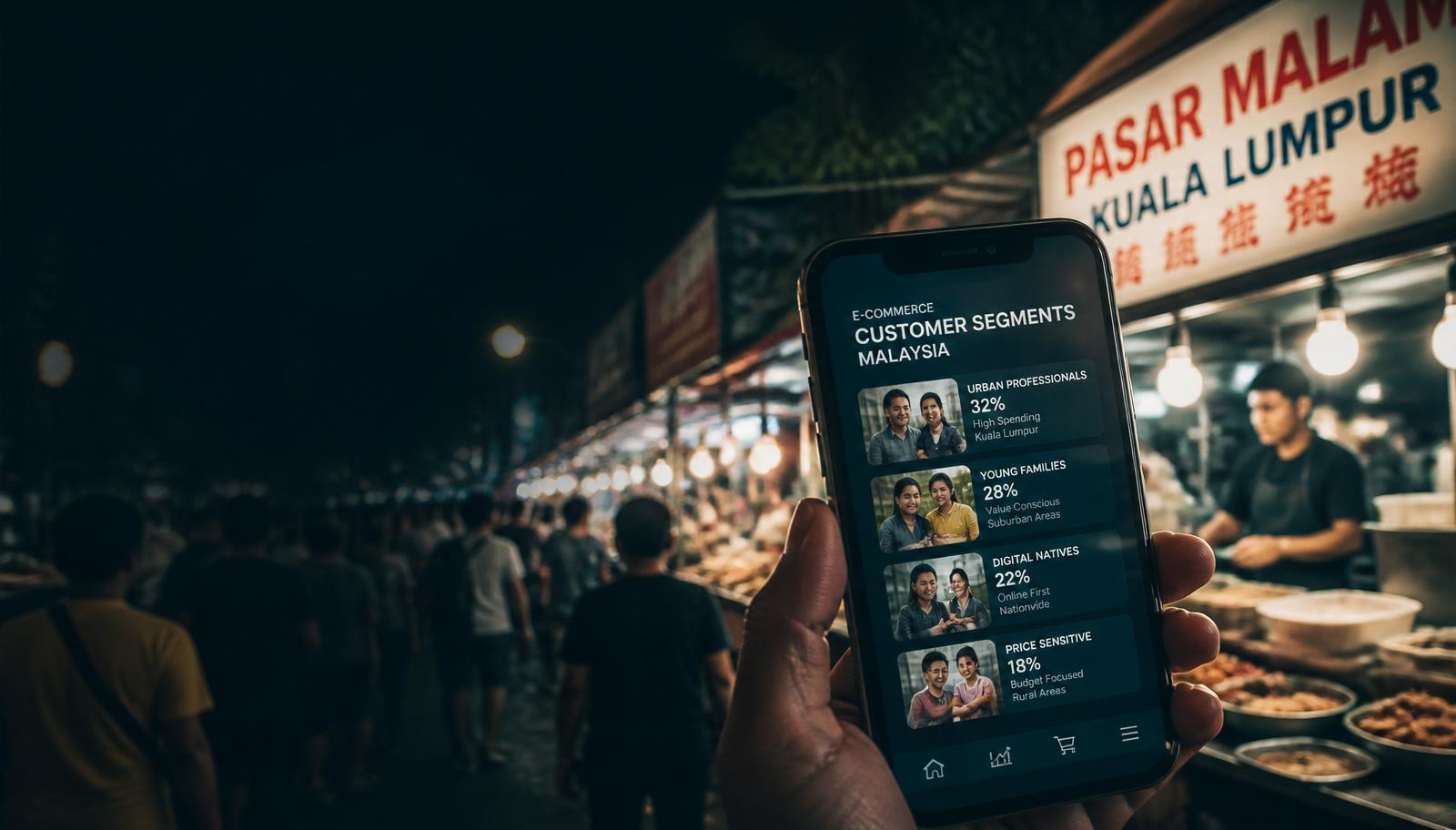


Segmentation is how you turn a pile of customers into groups that respond differently. For Malaysian ecommerce, the right segmentation strategy blends recency-frequency-monetary (RFM), lifecycle stage, behavioural signals, predicted value and propensity — layered onto a properly modelled first-party dataset. The mistake most teams make is choosing exotic segments before the basics work.
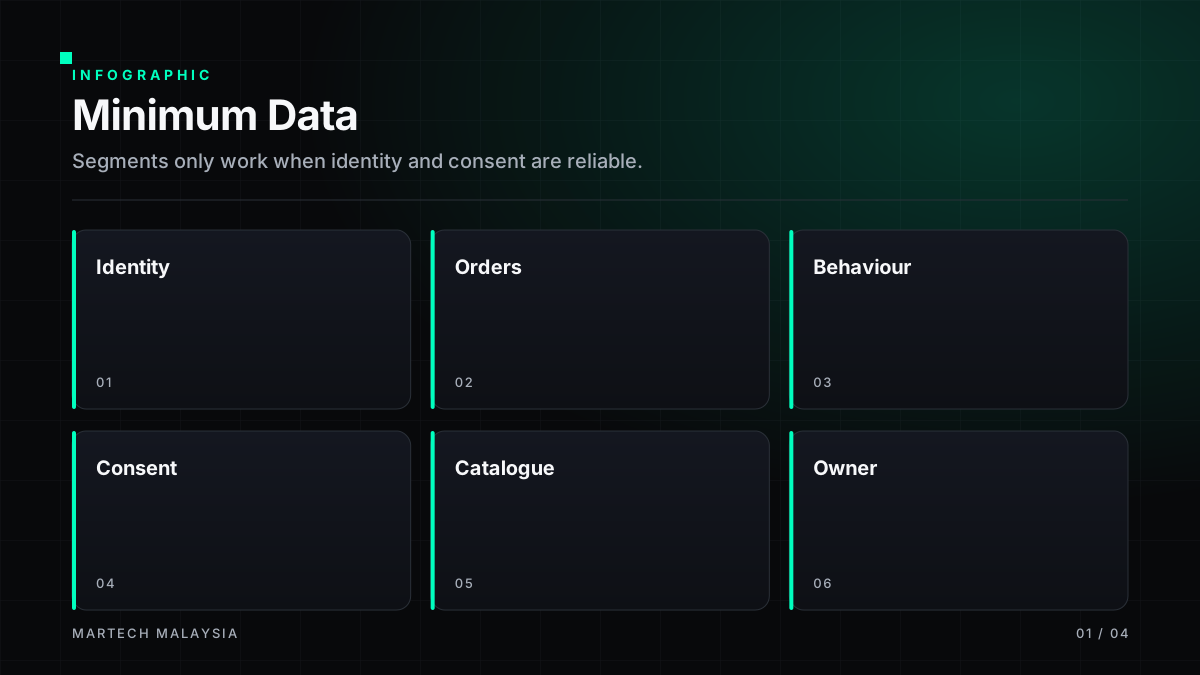
Minimum data requirements
Identity
Stable customer ID linking web, app, POS and CRM records. Hashed email and phone for activation matching.
Orders
Timestamped orders with items, category, value in MYR, tax and shipping — landed in warehouse or CDP.
Behaviour
Page/product views, cart events, checkout events, message opens/clicks. Server-side where possible.
Consent
Per-purpose consent state at the customer level, propagated to activation tools.
Reference data
Product catalogue with categories, price tiers, margin bands. Store/region for POS.
Ownership
Someone who signs off audience definitions and keeps them clean. Segmentation without an owner rots.
Recency, Frequency, Monetary (RFM)
RFM is the workhorse. It's cheap, interpretable and it works. Grade each customer on three dimensions:
| Recency (R) | Days since last order | Quintiles or business-defined bands (e.g. 0–30, 31–90, 91–180, 181–365, 365+) |
| Frequency (F) | Orders in a window (e.g. 12 months) | Quintiles or count bands |
| Monetary (M) | Revenue in a window | Quintiles by MYR spend |
From the grid you get named segments — Champions, Loyal, Potential Loyalists, At Risk, Hibernating, Lost. Each segment gets a treatment: retention offers, VIP care, winback series, sunset flows. Design the treatment before the segment.
Lifecycle segmentation
Anonymous
Unknown visitor. Objective: value exchange & identify.
Lead
Identified, no purchase. Objective: educate, remove friction, first order.
First-time buyer
One order. Objective: second purchase within a critical window (varies by category).
Repeat
2+ orders. Objective: raise frequency or basket.
Loyal / VIP
High F/M, low R. Objective: recognition, exclusivity, referral.
At risk / lapsed
Rising recency. Objective: winback, then respectful sunset.
Behavioural segmentation
Category affinity
Customers whose views and orders concentrate in a category (e.g. skincare vs makeup). Drives personalised recommendations.
Price sensitivity
Customers who convert only on discount vs those who buy full-price. Affects offer design.
Channel preference
WhatsApp openers vs email clickers vs app users. Different channel mixes yield different response.
Session intent
Browsers vs searchers vs re-engagers. Drives onsite personalisation.
Predictive & propensity segments
Predicted LTV
Model expected 12–24 month value. Prioritise acquisition and service against high pLTV cohorts.
Churn / lapse propensity
Probability of not purchasing again in the next N days. Trigger winback earlier for high-risk high-value customers.
Category propensity
Probability of purchasing in a specific category next. Feeds recommendations and merchandising.
Discount propensity
Probability that a discount is needed to convert. Protects margin on customers who would buy anyway.
Predictive segments are only useful when you have enough clean history to train them. If your order data is under six months old or full of gaps, stick with RFM until it is worth the modelling effort.
Value & margin segmentation
Revenue-based segments hide margin reality. A segment can be high in revenue and low in gross profit if it lives on discount. Segment on gross profit and contribution margin where the data allows, especially for retail categories with steep price laddering.
Journey examples
New visitor → first order
Identify via value exchange (10% first-order code, restock alert). Welcome flow: brand story, best-sellers, size/fit guidance, checkout nudge.
First-time buyer → repeat
Post-purchase education, replenishment reminder (if category fits), cross-category recommendations tuned to category affinity.
Repeat → VIP
Recognition (thank you at milestone spend), early access, referral offer. WhatsApp is often the highest-response channel here.
At risk → winback → sunset
Two-touch winback with a genuine reason to return, then respectful sunset — reduces list rot and improves deliverability.
Experiment design & holdouts
Define the decision
What action would a positive result change? If nothing, don't run the test.
Design the holdout
Randomly withhold a portion (e.g. 10–20%) of the eligible audience. Match on key covariates when the audience is small.
Pick the metric
Incremental revenue per recipient over a defined window. Not open rate. Not clicks.
Pre-register the analysis
Window, metric, exclusions and success criteria agreed before the send.
Read, decide, retire
Ship the winning treatment; retire the audience if it never moves a metric.
Maturity ladder
Level 1 · List & blast
One audience, no segmentation. Broad promotions.
Level 2 · Basic RFM & lifecycle
Champions, at-risk, first-time buyers. Simple treatments per segment.
Level 3 · Behavioural layers
Category affinity, channel preference, price sensitivity. Cross-channel journeys.
Level 4 · Predictive
pLTV, churn/lapse propensity, discount propensity. Suppression and prioritisation across channels.
Level 5 · Programmatic
Segments defined once, activated everywhere, measured with holdouts. Retired routinely. Governed under PDPA.
Pitfalls
Segment sprawl
Fifty audiences, all with the same treatment. Collapse or delete.
Vanity metrics
Optimising open rate while total gross profit falls. Change the metric before you change the segment.
No holdouts
Uplift claims without holdouts are not measurements. They are anecdotes.
PDPA blind spots
Segmenting on inferred sensitive attributes without a clear purpose and consent — a policy and a legal problem.
Frequently asked questions
How many segments should we run?
As few as change the treatment. If two segments get the same email at the same time, they are one segment.
Do we need a CDP for this?
Not to start. A warehouse + BI tool + ESP with segmentation can carry you a long way. As channels multiply, CDP-like capabilities save time. See the practical guide to CDPs.
Does this apply to B2B?
Yes. Replace RFM with account activity (last engagement, product usage, buying-committee touches). Lifecycle, propensity and holdouts still apply.
How does PDPA affect segmentation?
Every segment used for marketing must sit on customers whose marketing consent is current for that purpose. Withdrawal must cascade. See the PDPA marketer playbook.
What uplift should we expect?
We won't quote a universal number. The right answer is "whatever your holdout says." Publish it internally; use it to decide what to keep.
Related reading
Practical guide to CDPs · First-party data strategy · CDP vs CRM vs DMP · PDPA compliance · Talk to us.
Sources & further reading
All sources retrieved 17 July 2026.